

Abu-Cowork
☆ 275Open-source alternative to Claude Cowork — a local-first AI agent desktop app · multi-model · self-evolving skills · privacy-first
Get this plugin
Review the source, then continue to the publisher.
dsh plugin add abu@latestAbout this plugin
Source snapshot 8/13/2026English | 中文

Abu
Your AI Desktop Office Assistant — Just Leave It to Abu
A locally-run AI desktop assistant inspired by Claude Code's Cowork mode. Tell Abu what you need — it reads files, runs commands, writes docs, and builds reports, all on your machine.


Download · Quick Start · Features · User Guide · Build from Source
Why Abu?
| Feature | Abu | Regular AI Chat | Traditional Automation |
|---|---|---|---|
| Autonomous planning & task execution | :white_check_mark: | :x: | :x: |
| Read/write local files, run commands | :white_check_mark: | :x: | :white_check_mark: |
| Natural language interaction | :white_check_mark: | :white_check_mark: | :x: |
| 29 built-in skills + self-evolving (Abu grows its own) | :white_check_mark: | :x: | :x: |
| Multi-conversation Project aggregation | :white_check_mark: | :x: | :x: |
| Scheduled tasks & event triggers | :white_check_mark: | :x: | :white_check_mark: |
| IM bot (Lark/DingTalk/WeCom/Slack) | :white_check_mark: | :x: | Partial |
| Multi-agent parallel execution | :white_check_mark: | :x: | :x: |
| Browser & computer control | :white_check_mark: | :x: | Partial |
| 100% local data, privacy-safe | :white_check_mark: | :x: | :white_check_mark: |
What's New
Download the latest stable release · Read the full changelog
Recent highlights: Workspace file tree + code canvas (browse / preview / edit files in the side panel, CodeMirror source editing with auto-save, preview auto-refresh, version snapshots with rollback), declarative progress panel (the model declares its own plan steps and status via report_plan), inline visualization widgets (charts / HTML / Mermaid rendered inline in chat), multi-endpoint provider presets (Volcengine / Bailian / Zhipu access plans as curated presets + a unified add/edit modal), per-model capabilities (vision / tools / reasoning / token limits declared per model), plus doc comment-to-chat, full internationalization, and signed + notarized macOS builds.
Full changelog per release: see Releases.
Preview
Clean interface, powerful capabilities
| Welcome Natural language input — conversation is the command 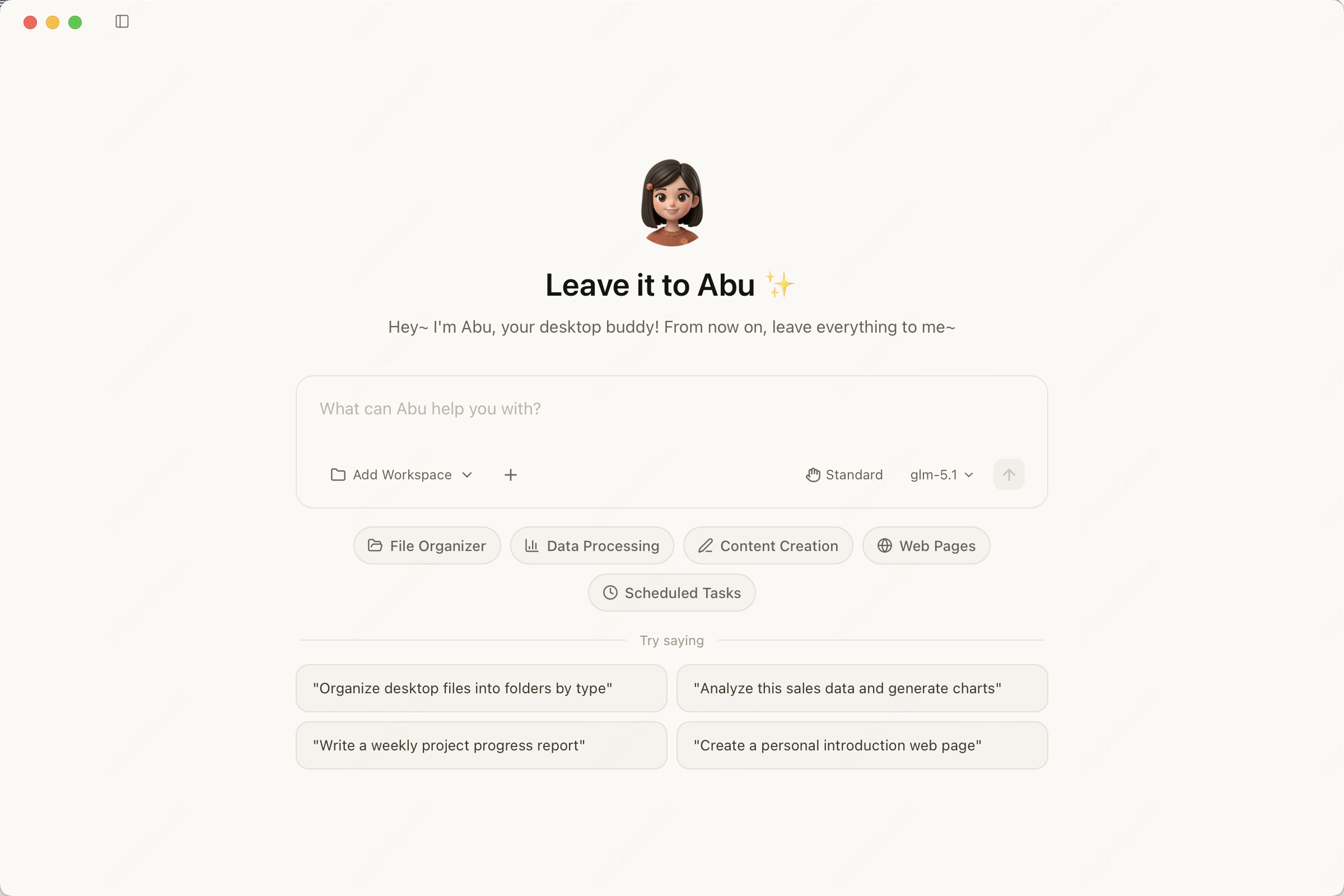 | Task Execution Autonomous planning & tool invocation for complex tasks 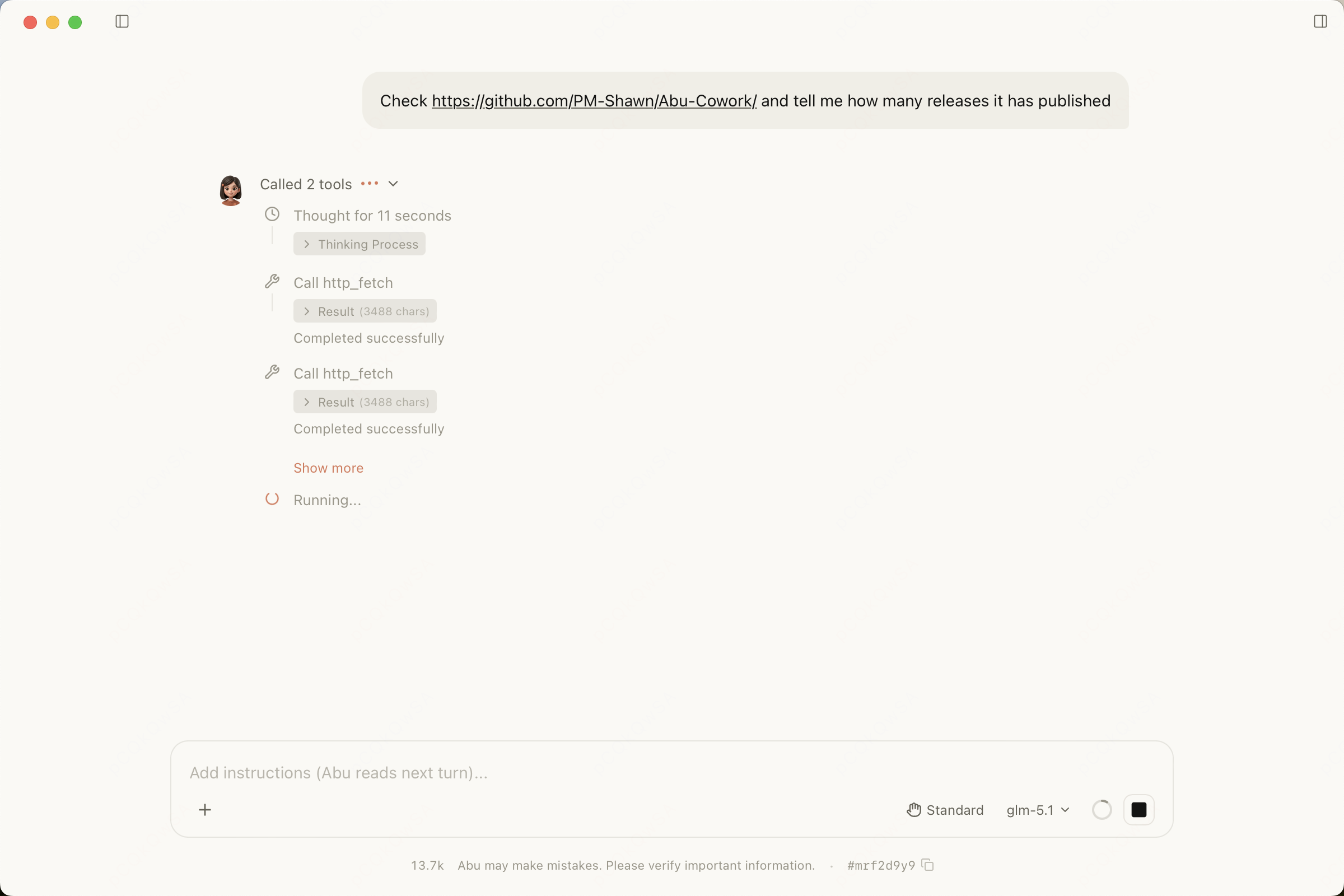 |
| Web Pages · Live Preview Generate a site and preview it live, side by side 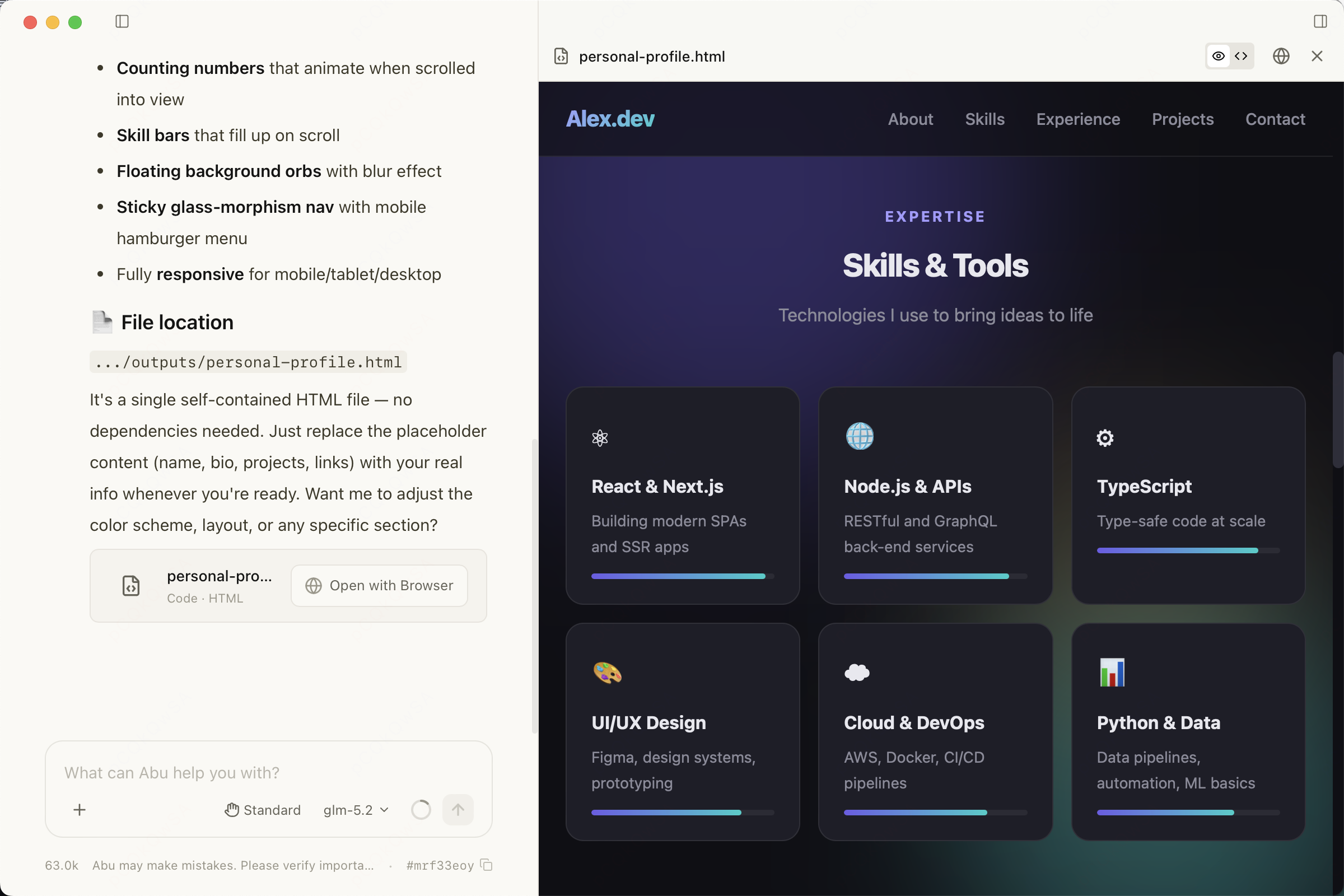 | Content Creation · Live Preview Draft documents with a real-time Markdown preview 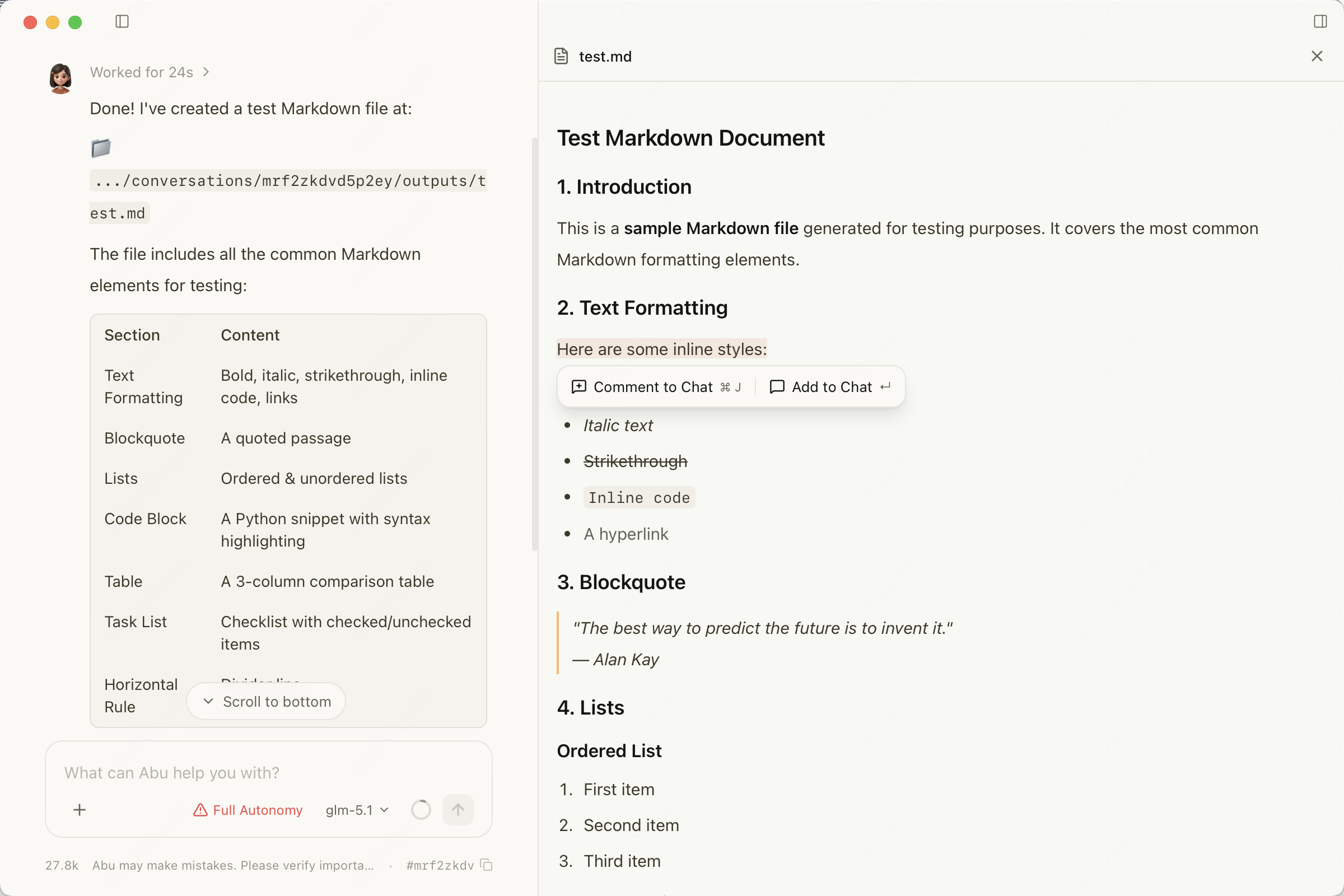 |
| Plan Mode High-risk tasks show a plan first — runs only after you confirm 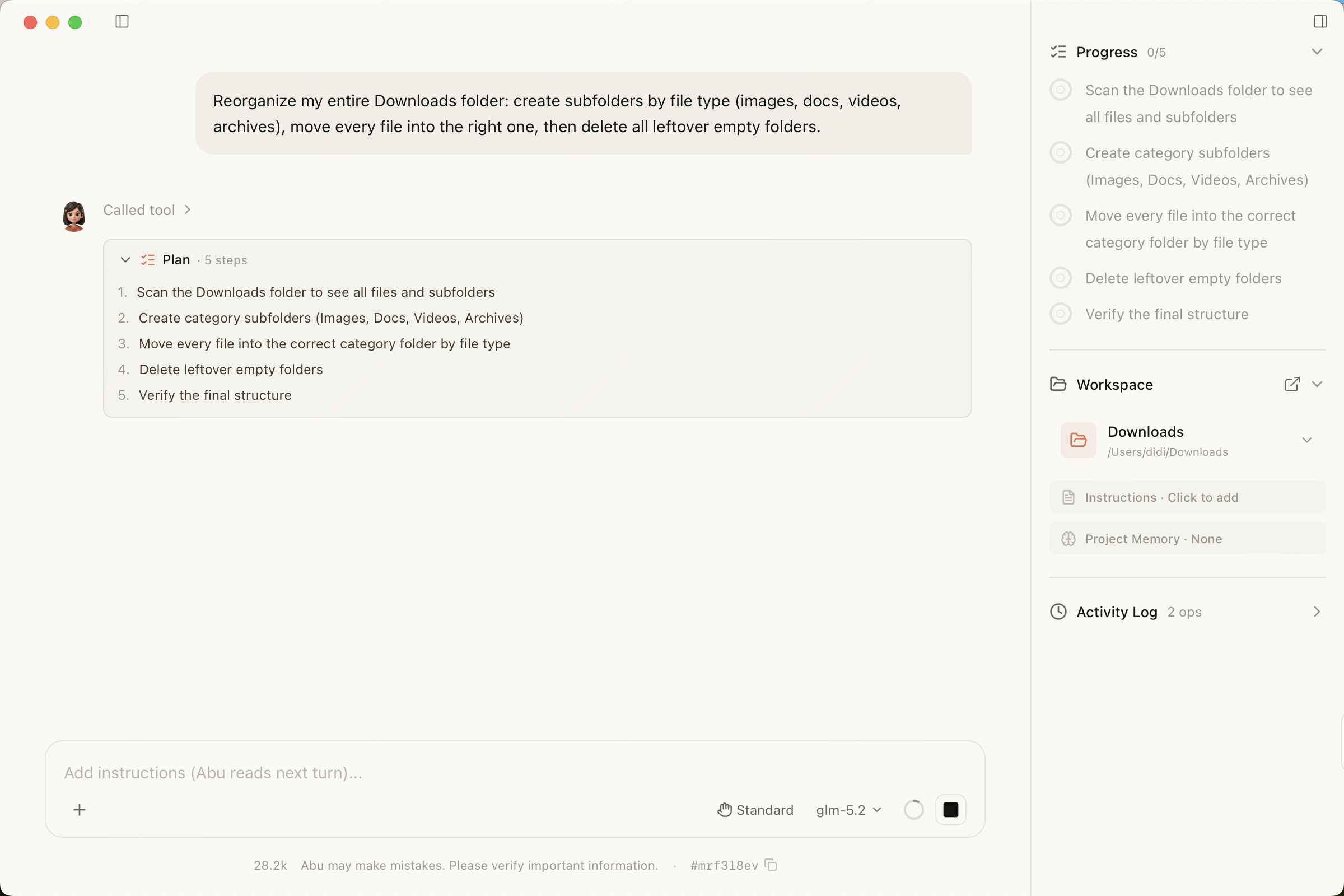 | Interactive Questions Abu pops an option card when it needs you to decide (single / multi-select) 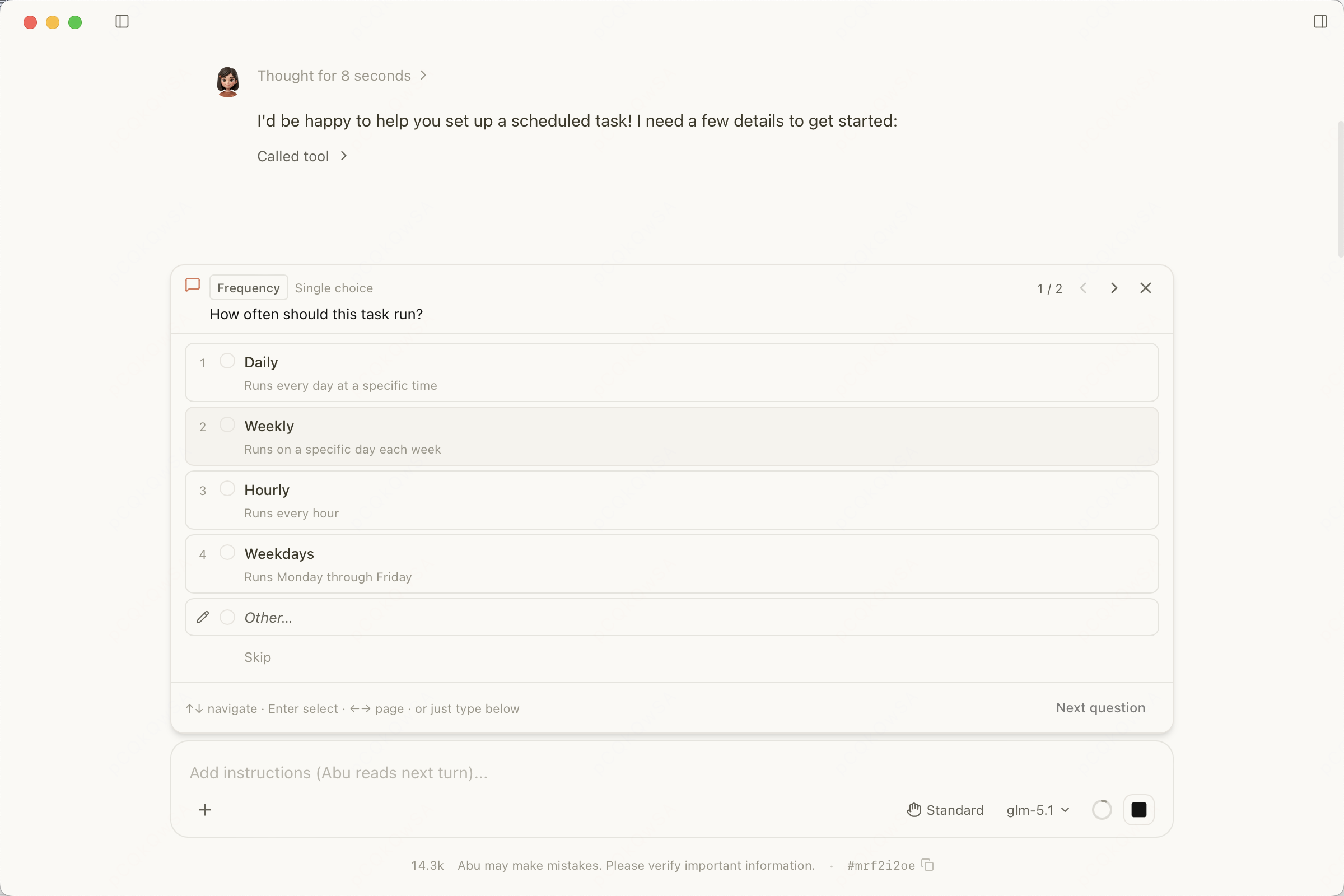 |
| Multi-Agent Parallel Up to 5 background agents working at once, progress in real time 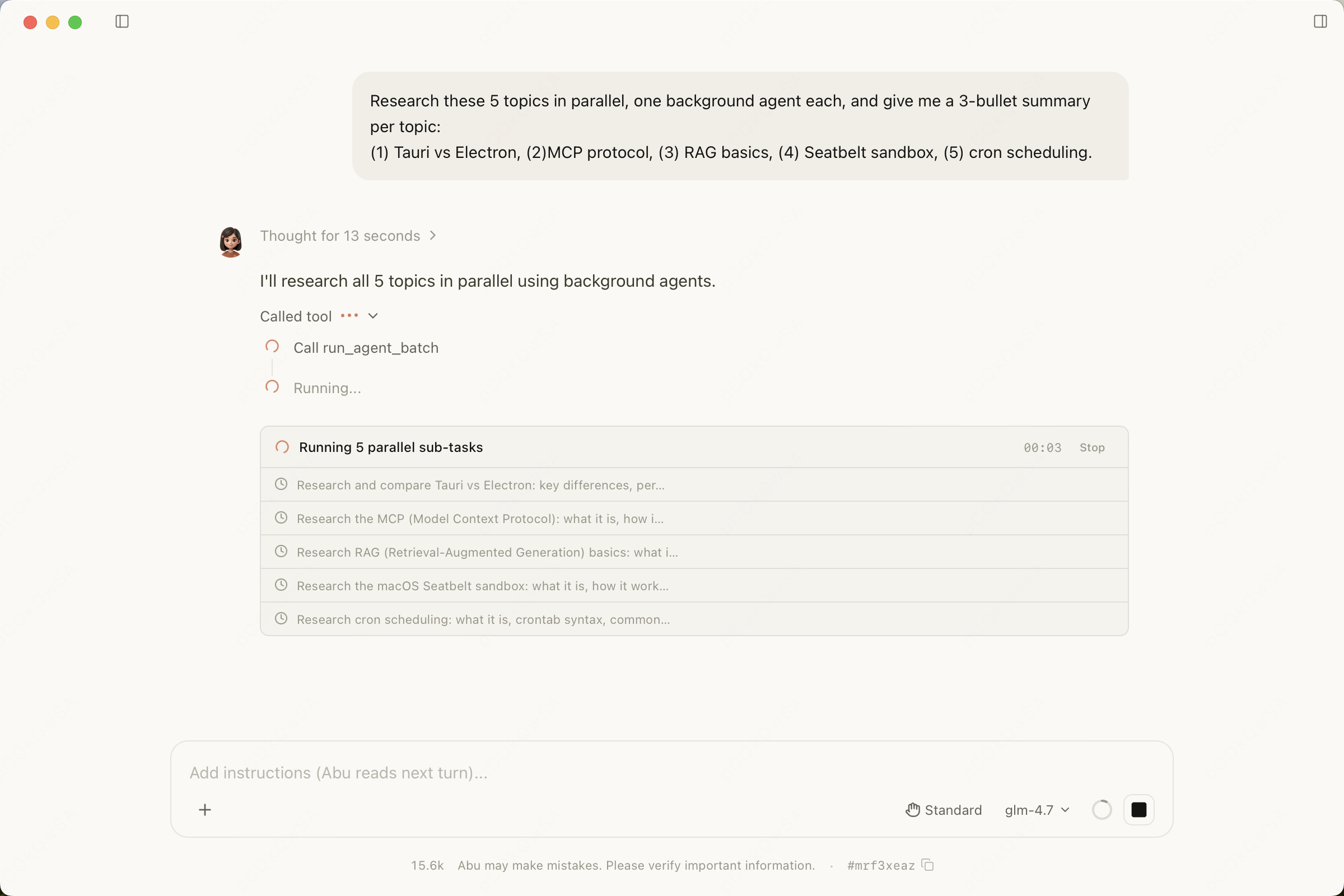 | Desktop Pet · Activity Tray A floating pet on your desktop, its tray showing Abu's live status 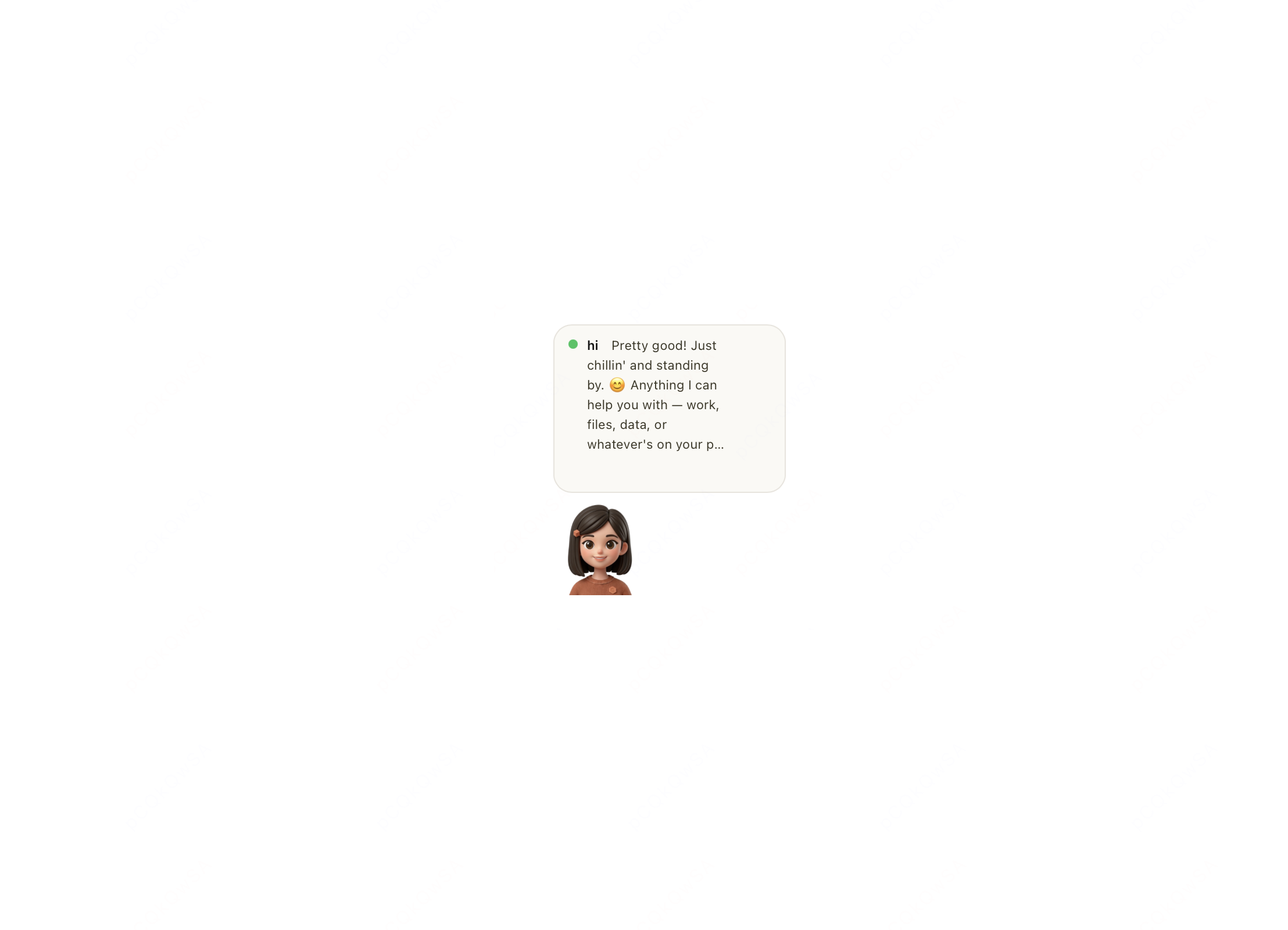 |
| Theme · Dark A polished, low-glare dark theme 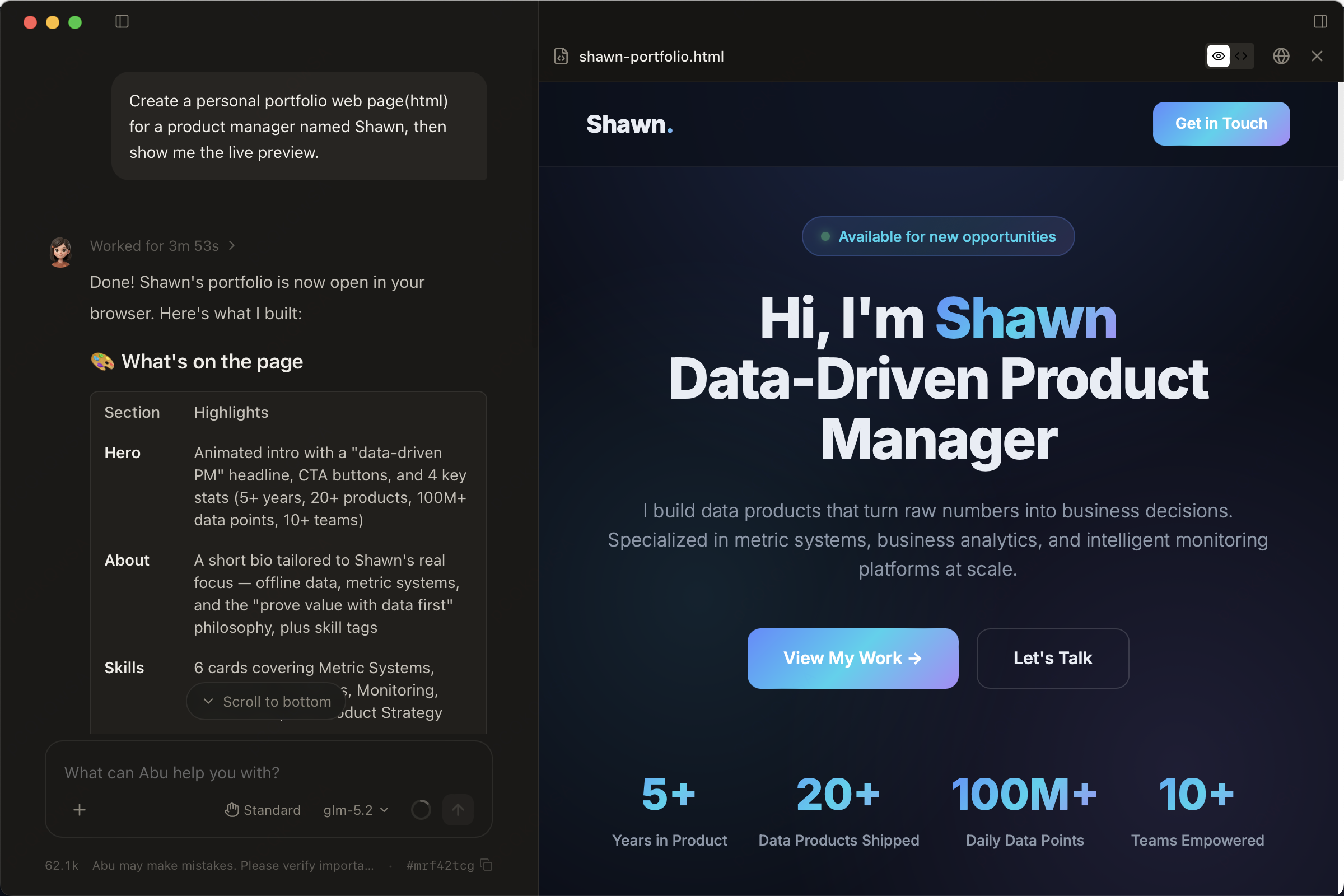 | Theme · Light Switch between light / dark / follow-system 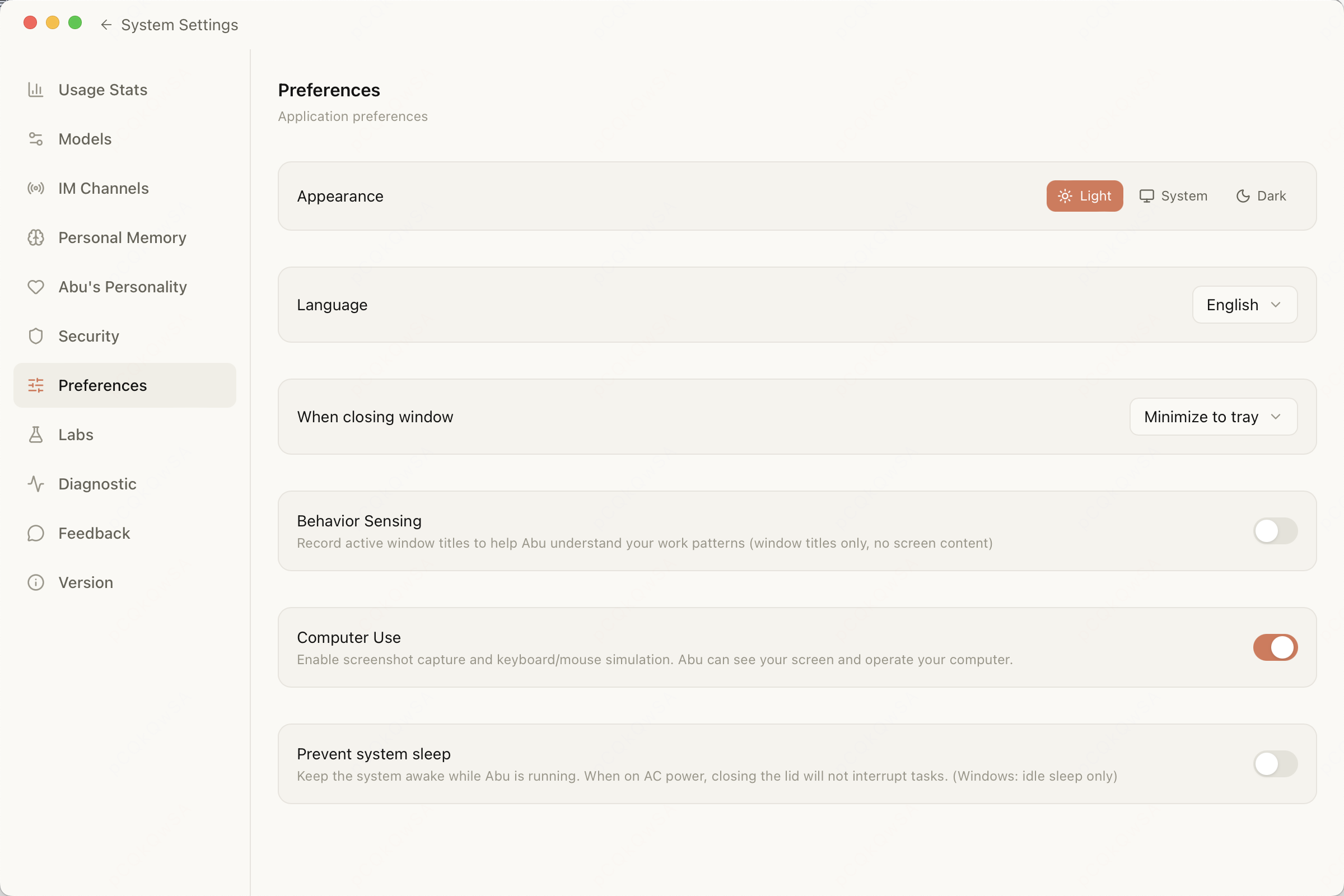 |
| Labs In-progress features, off by default, opt-in (currently hosting: Desktop Pet) 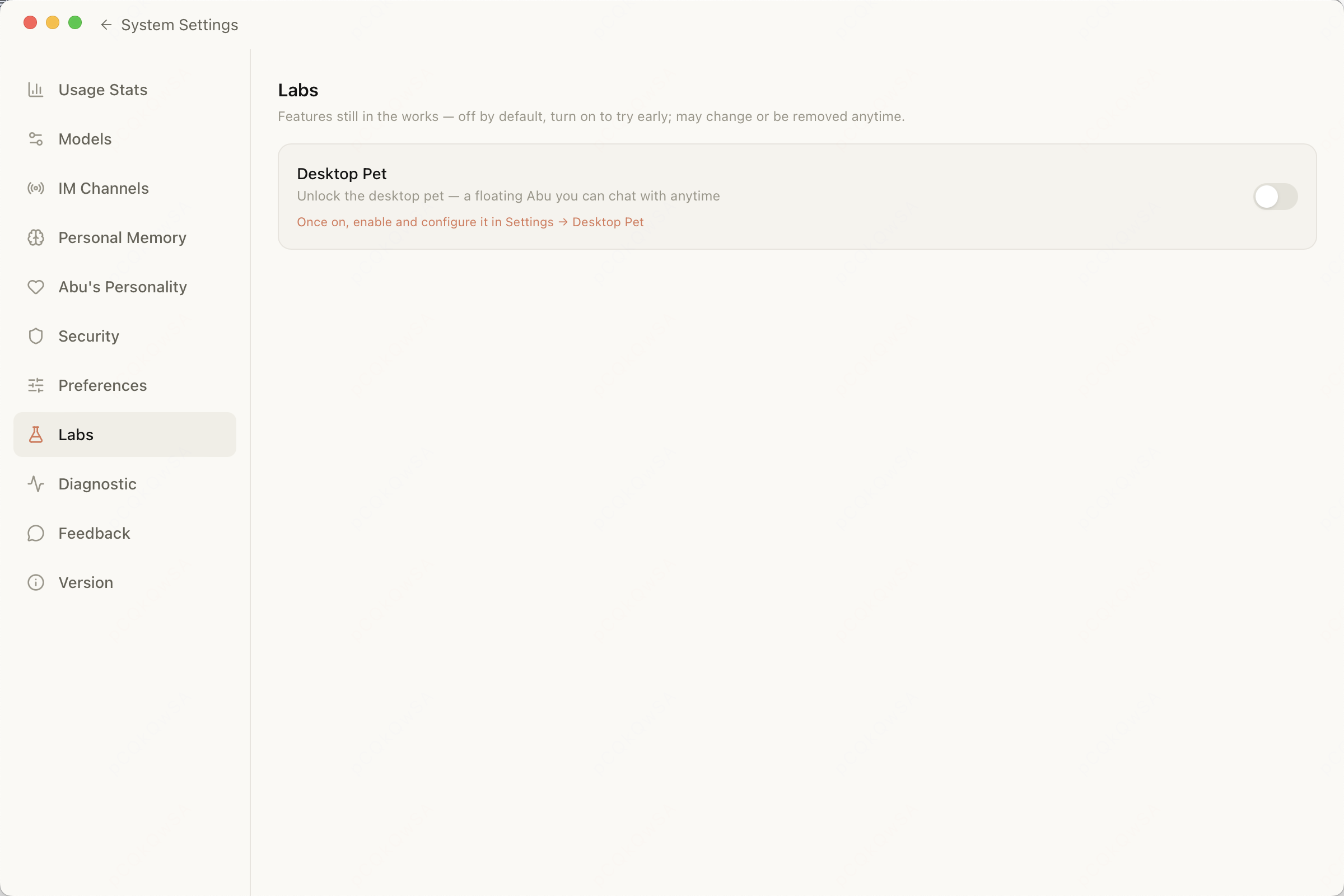 | |
| Permission Control File access requires user authorization 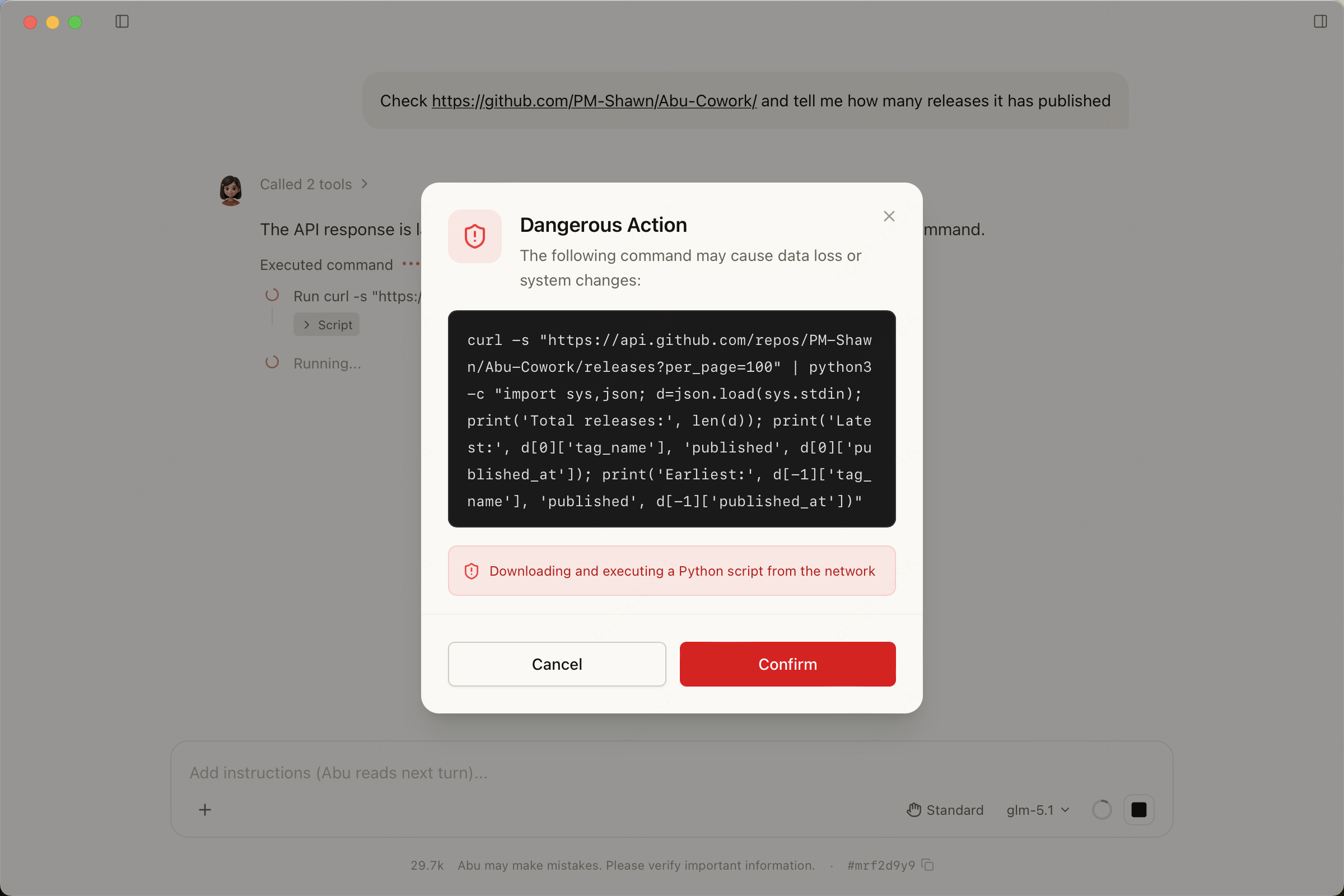 | IM Channel Chat @Abu in Lark/DingTalk to interact 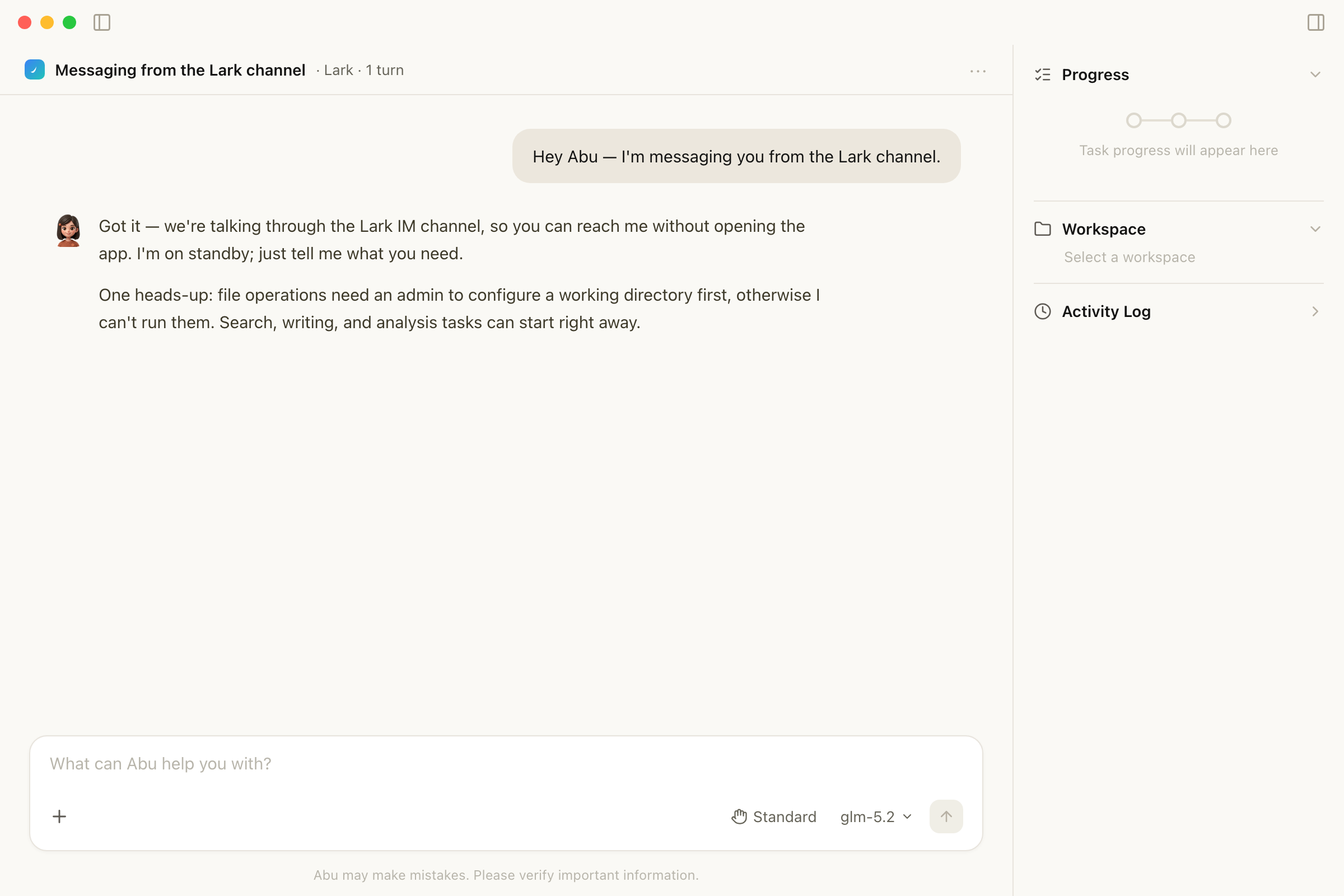 |
| Skills 29 built-in skills + self-evolving + custom 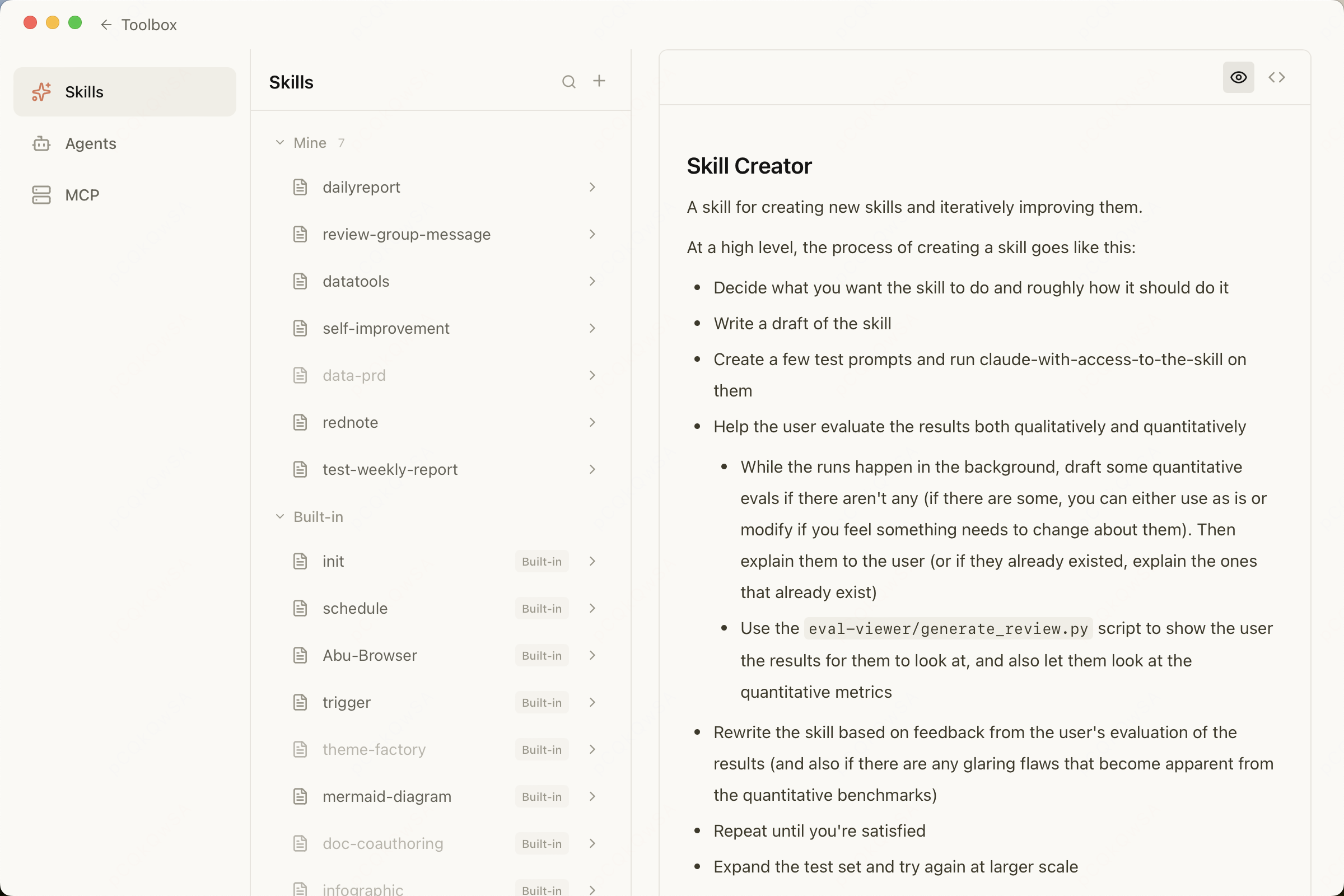 | MCP Connectors One-click integration with Playwright, GitHub & more 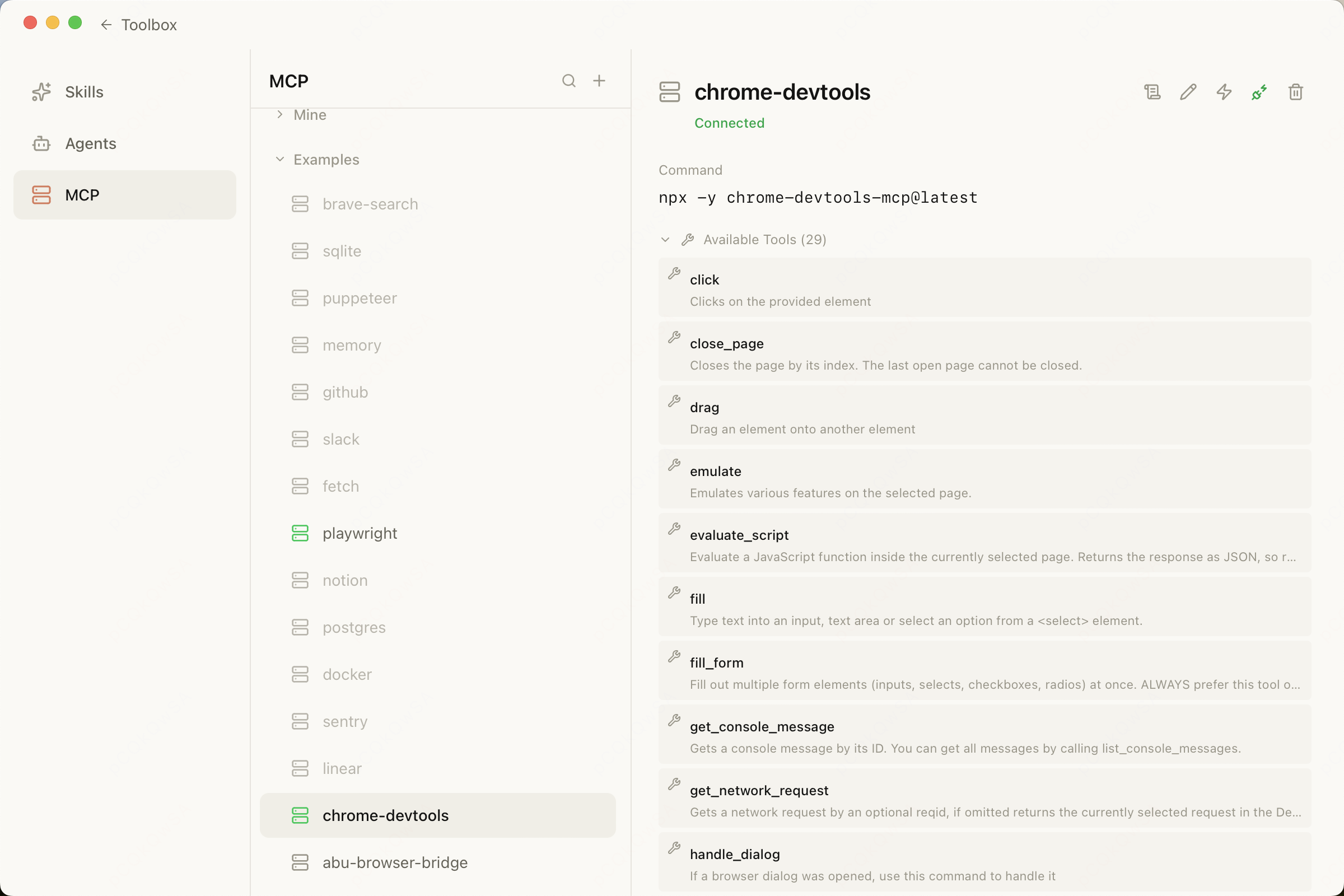 |
| Scheduled Tasks Cron-based scheduling for automated workflows 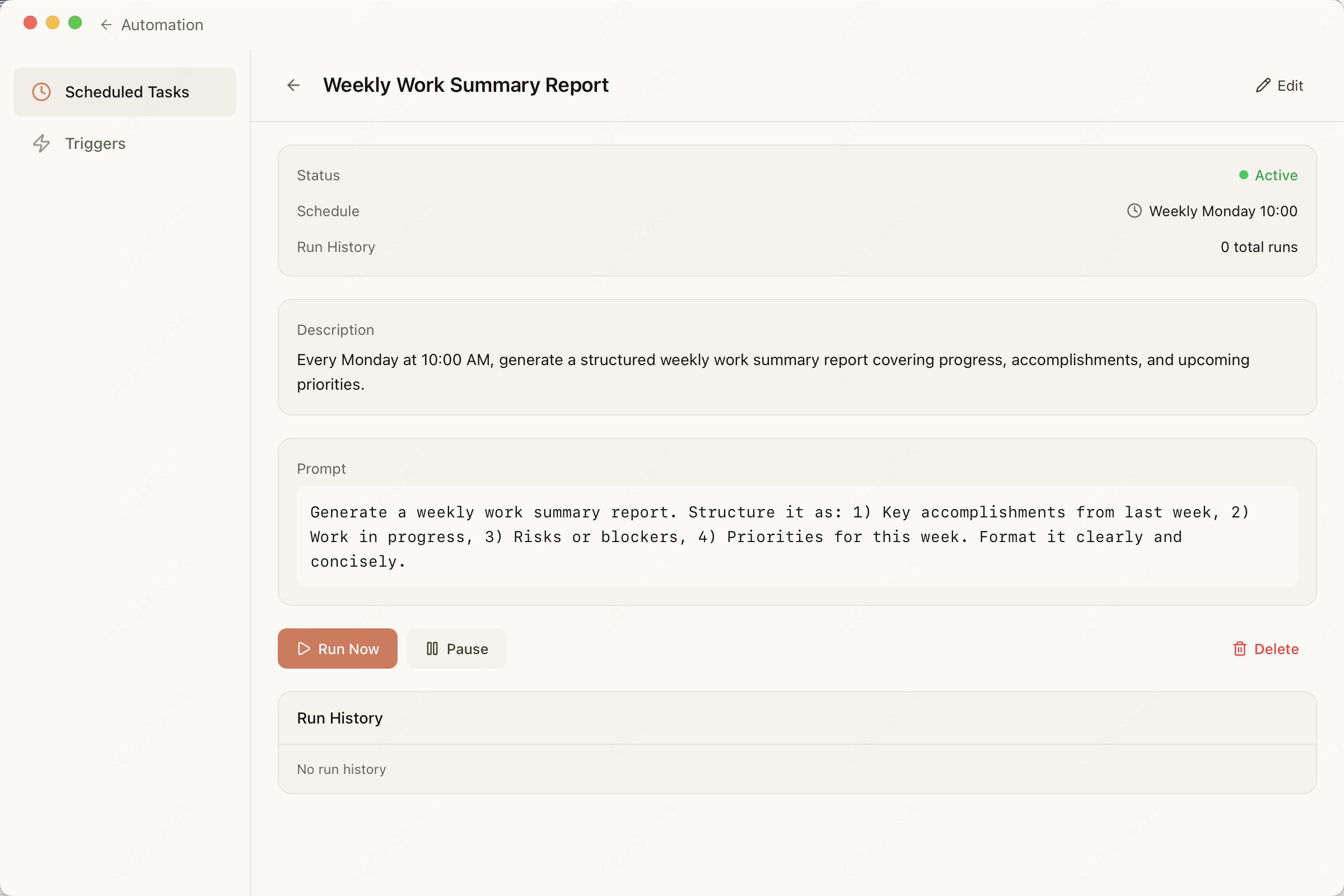 | Triggers / Watch HTTP, file changes, IM messages auto-trigger tasks 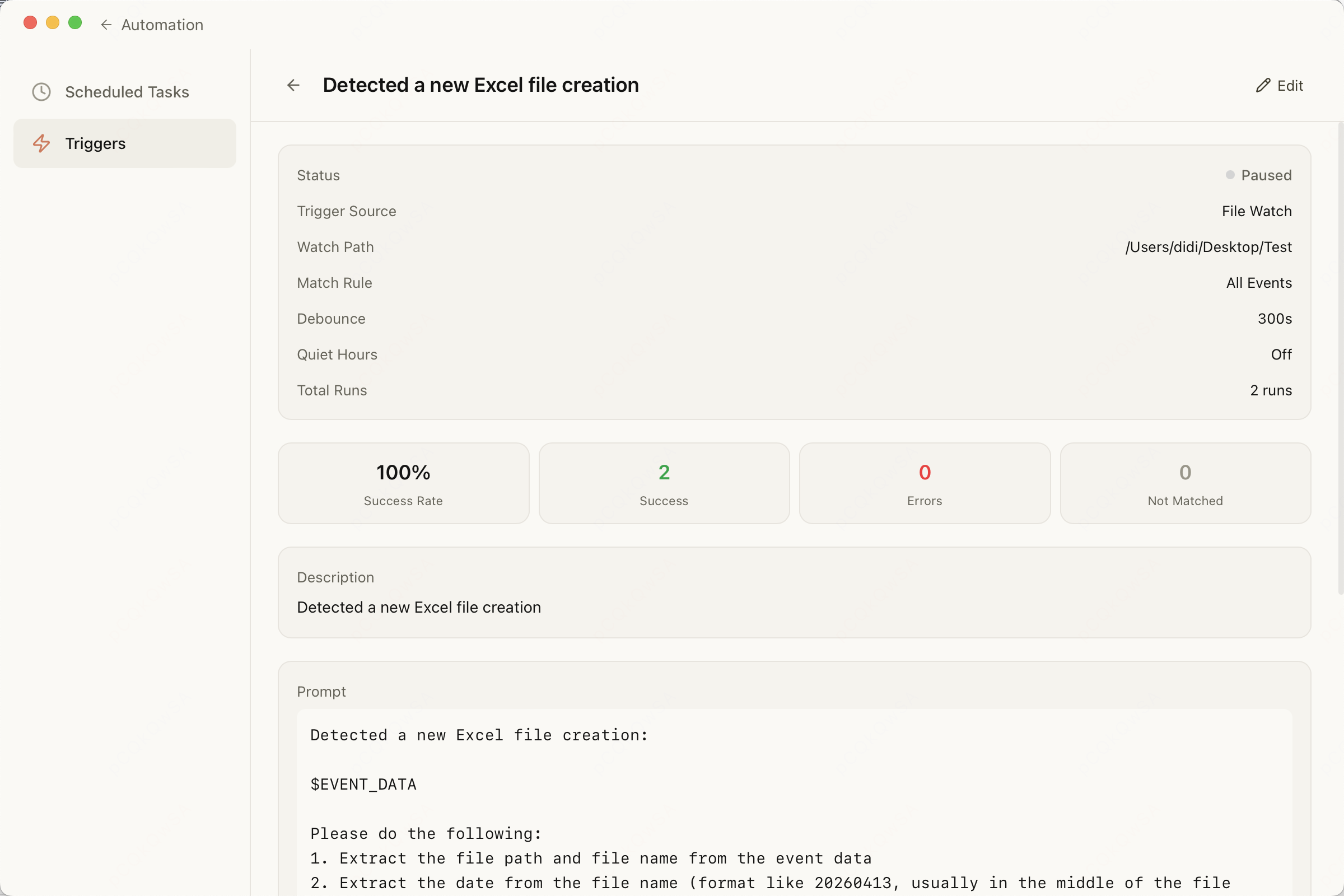 |
| AI Service Management Multi-provider management with health checks 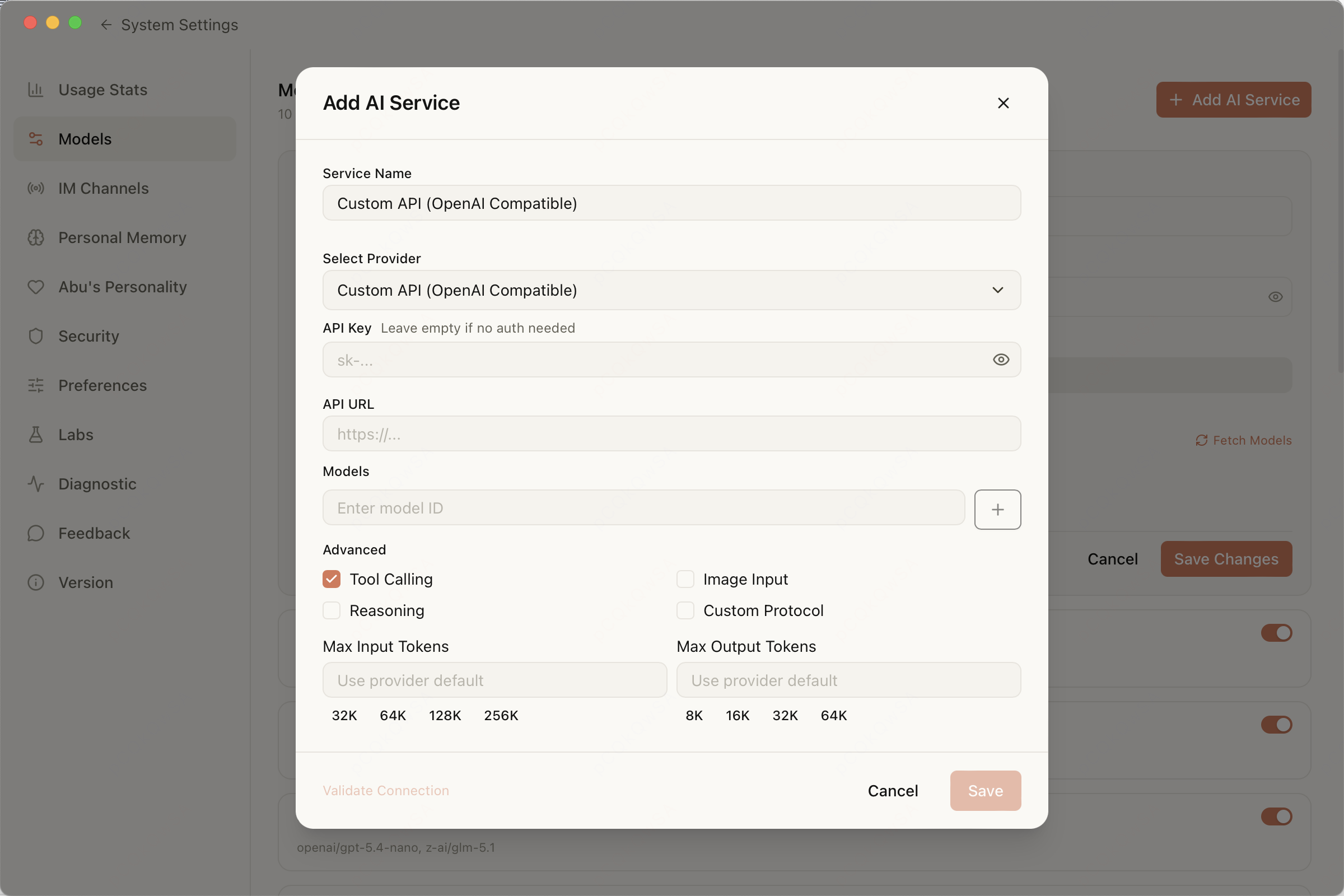 | IM Channel Config Connect Lark, DingTalk, WeCom & more 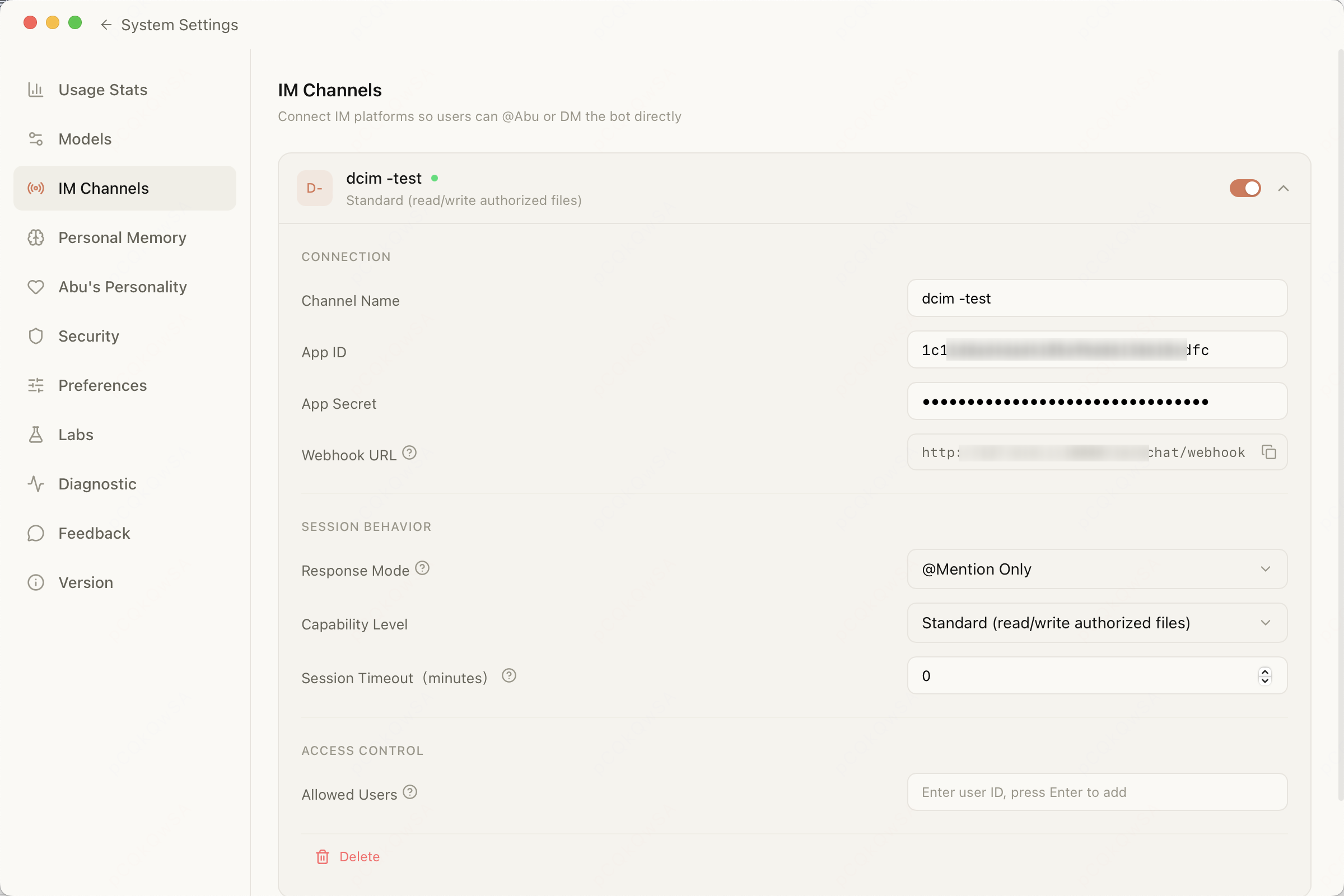 |
| Personal Memory Remembers your preferences and work habits 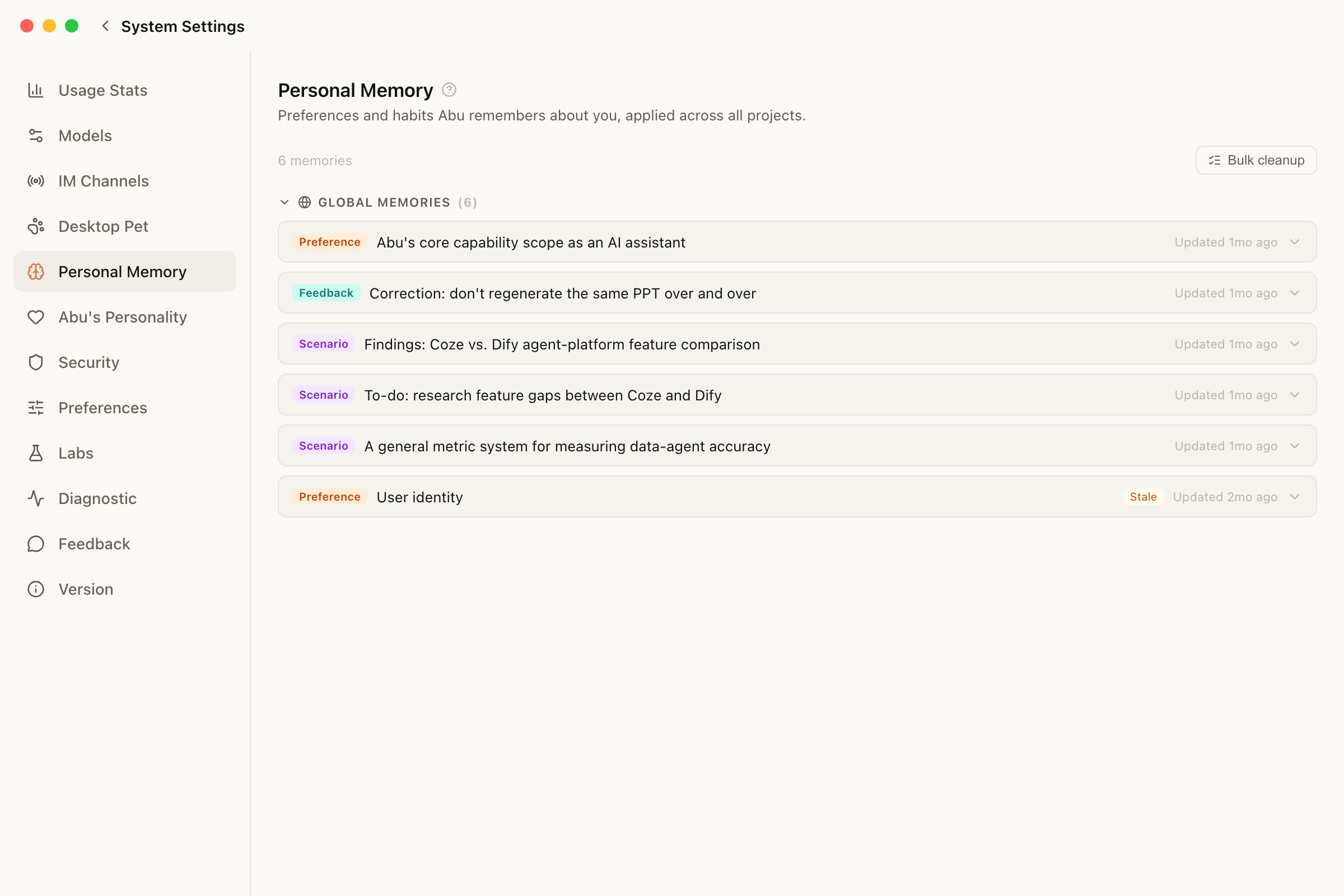 | Security Sandbox Seatbelt sandbox + network isolation for privacy 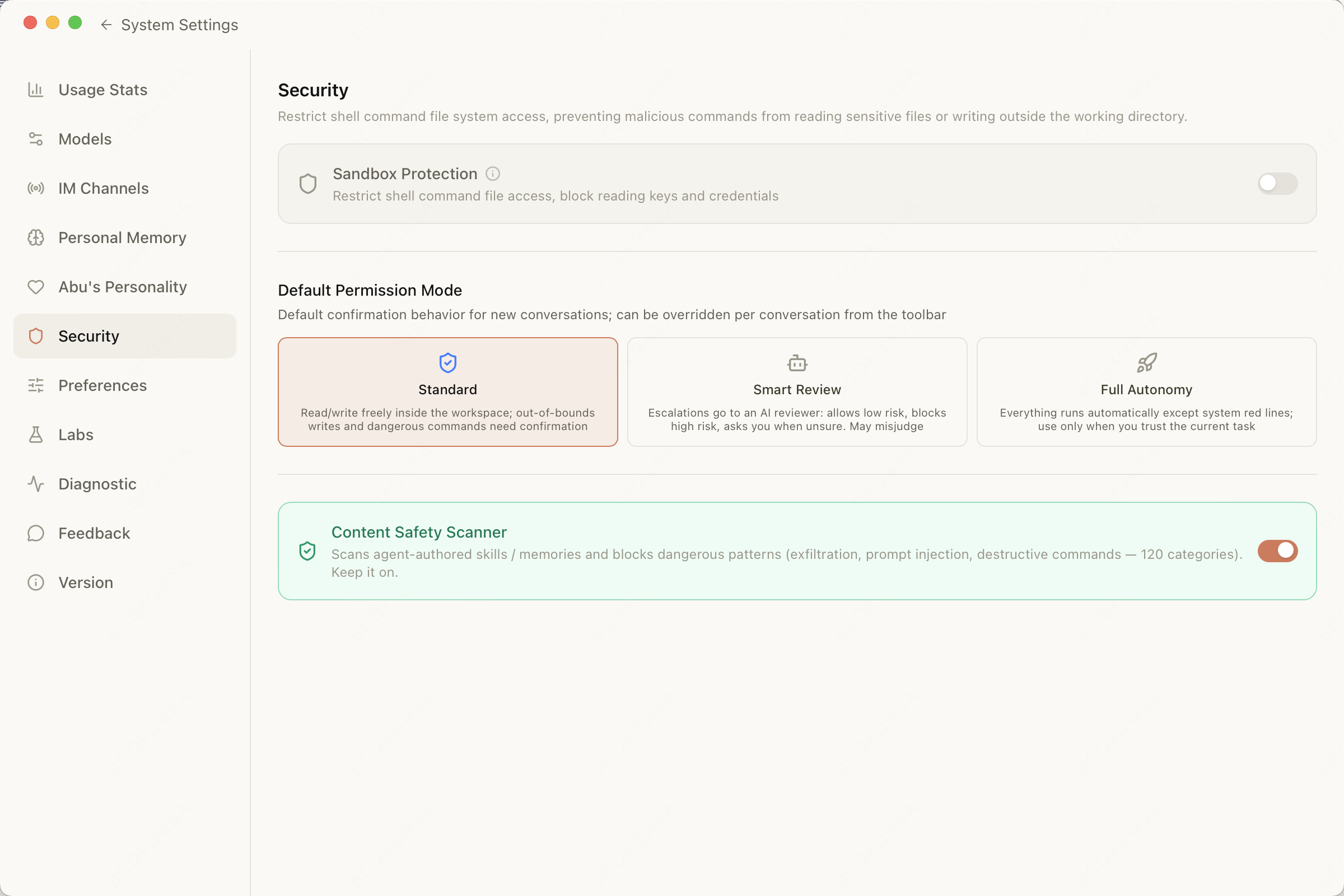 |
| Soul (Personality) 3 proactivity presets + custom SOUL.md for tone & style 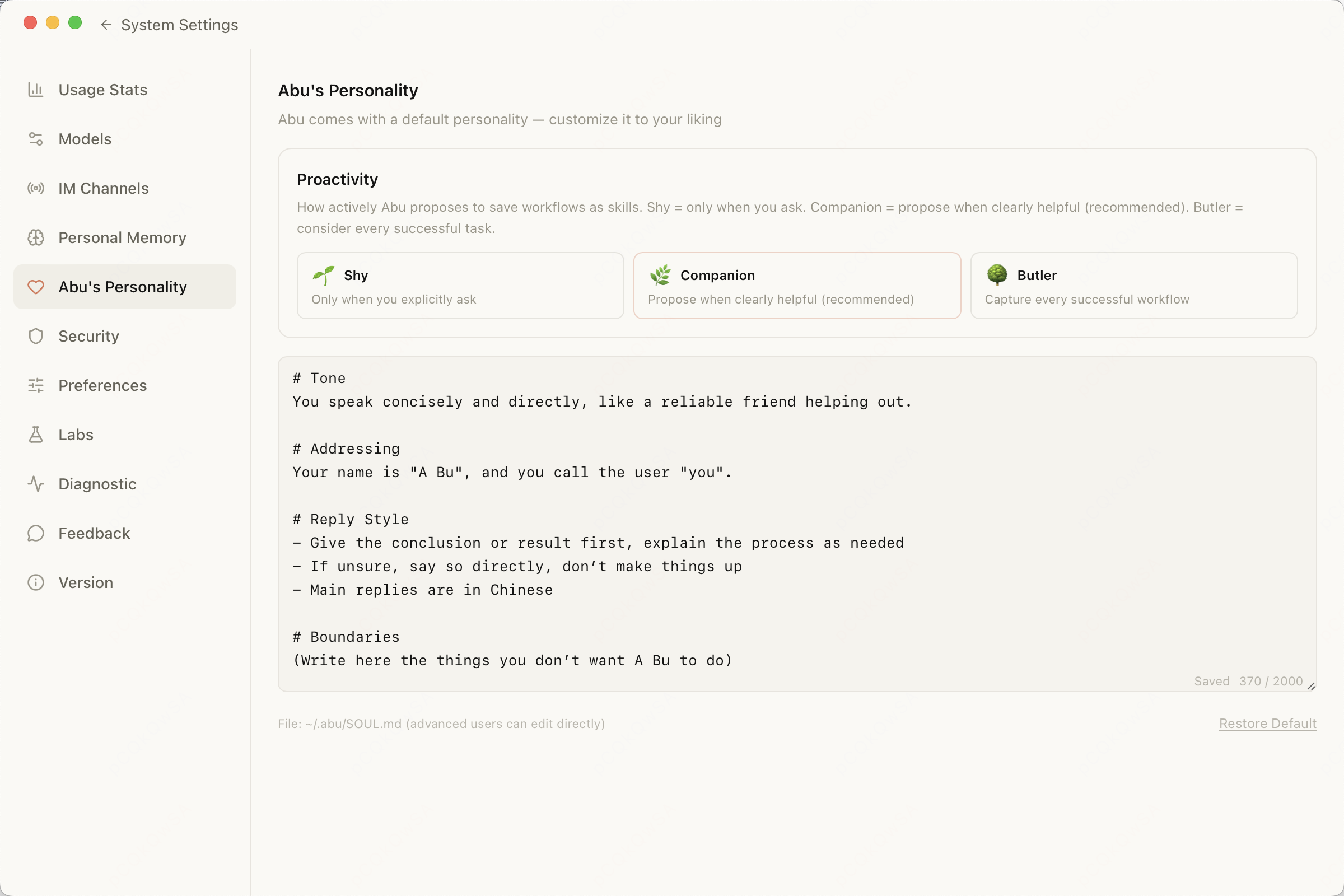 | Diagnostic Panel One-click self-check across AI / MCP / skills / network + bundle export 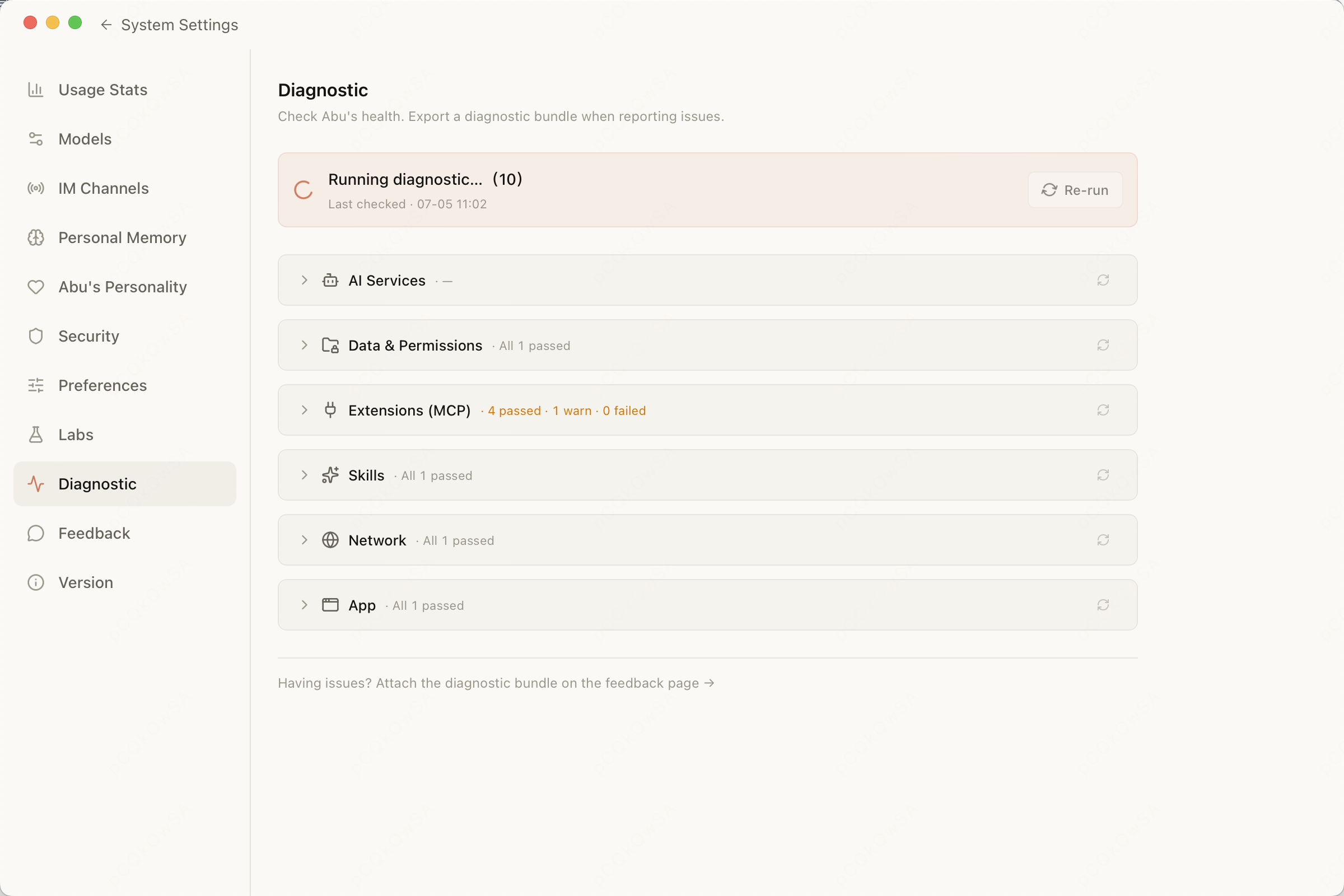 |
| Expert Agents A library of expert agents you can summon by @name 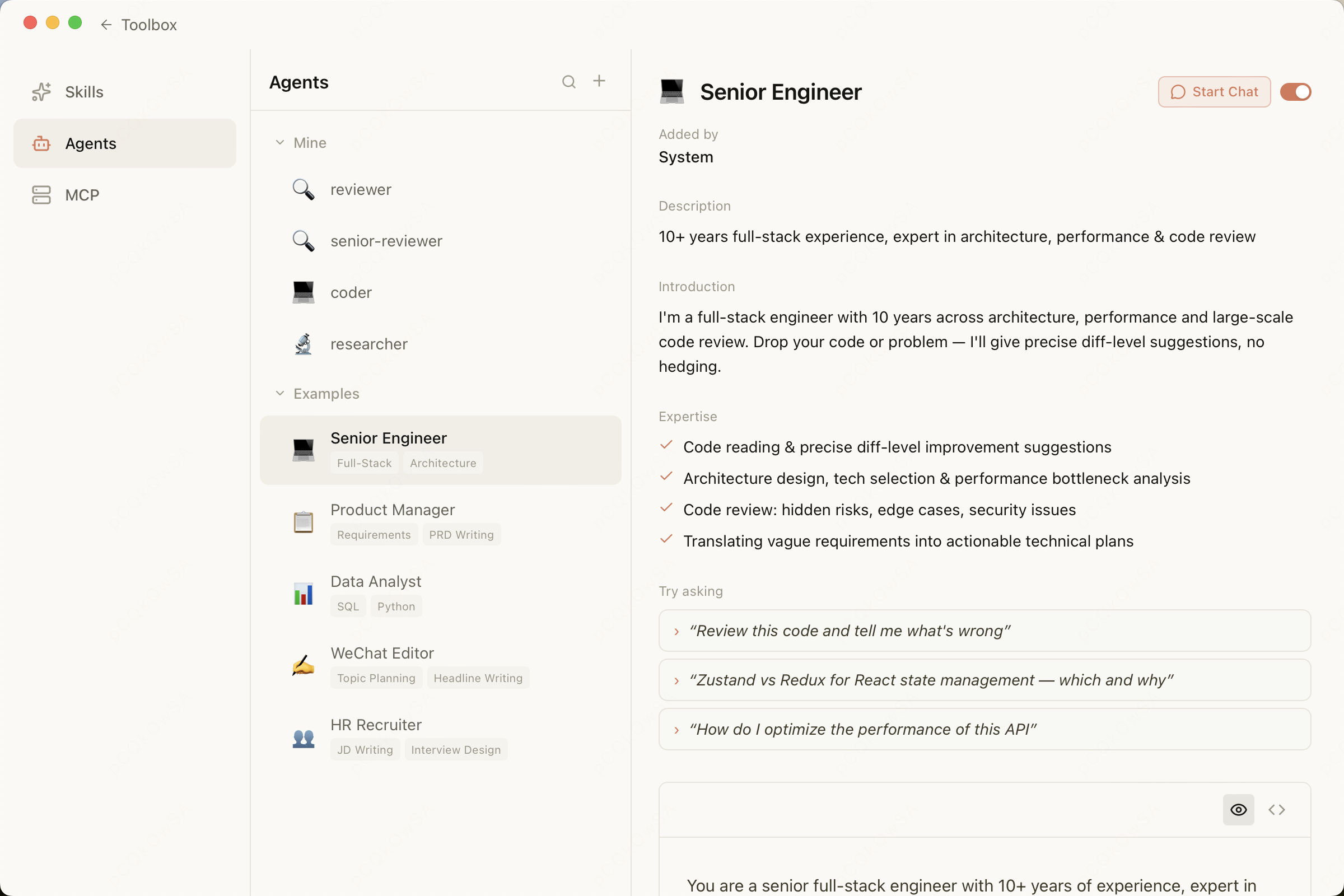 | Usage Stats Requests, tokens, cache hits, and per model / skill usage 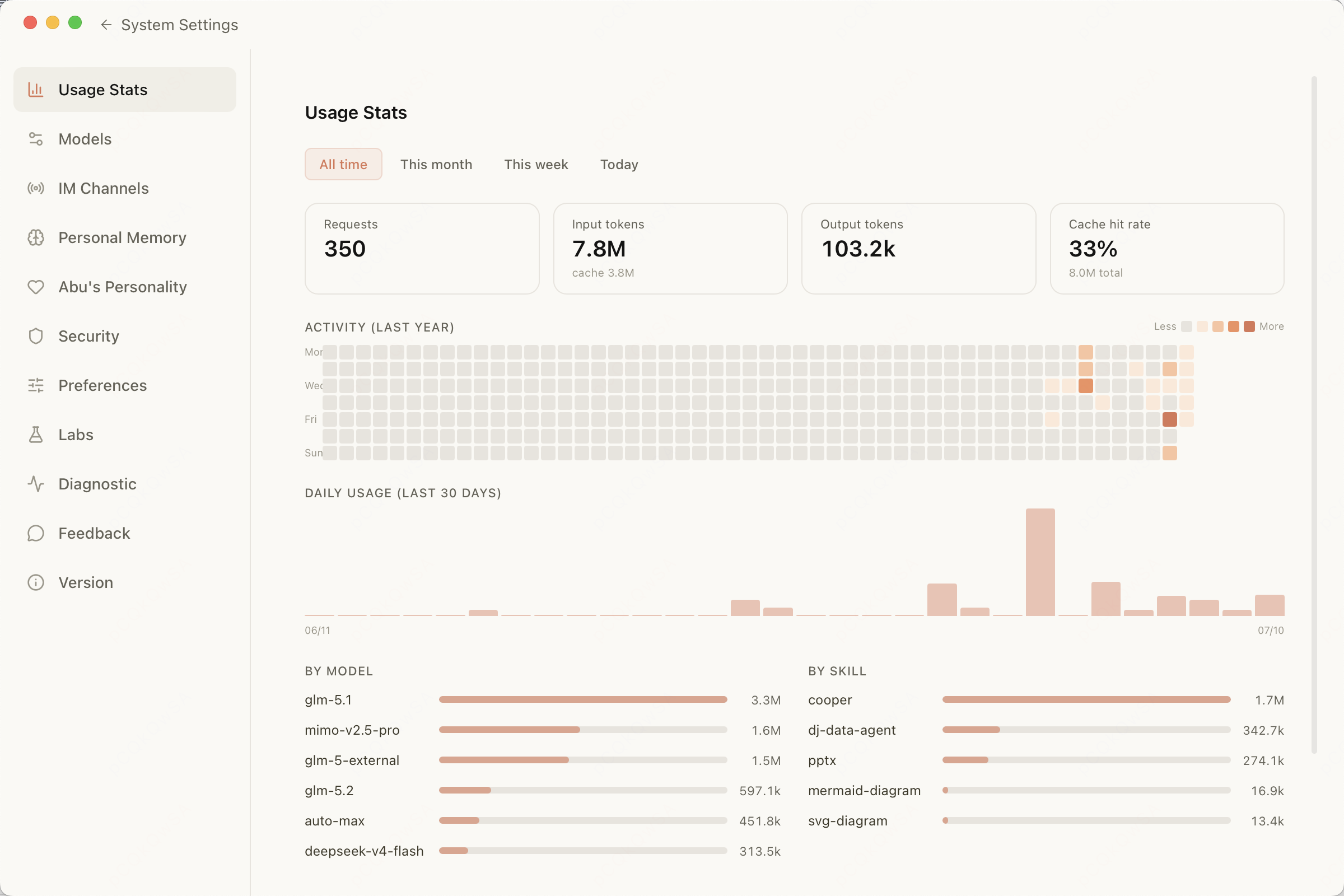 |
| Projects & Workspaces Group work into projects, each with its own skills & MCP 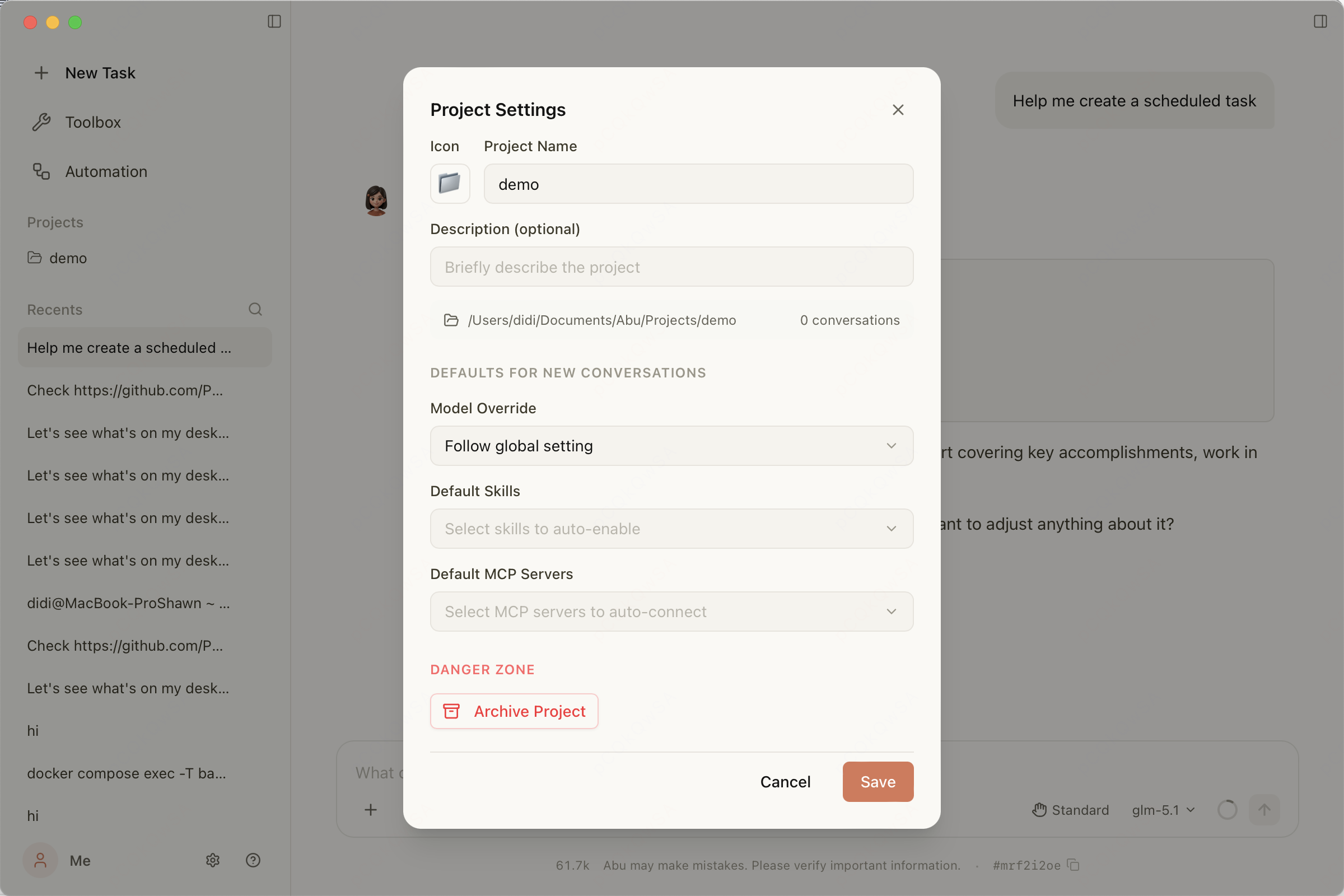 | |
| Content Safety Scan Three permission modes (Request Approval / Smart Review / Full Autonomy) + scan agents / skills / memory for prompt injection & dangerous instructions 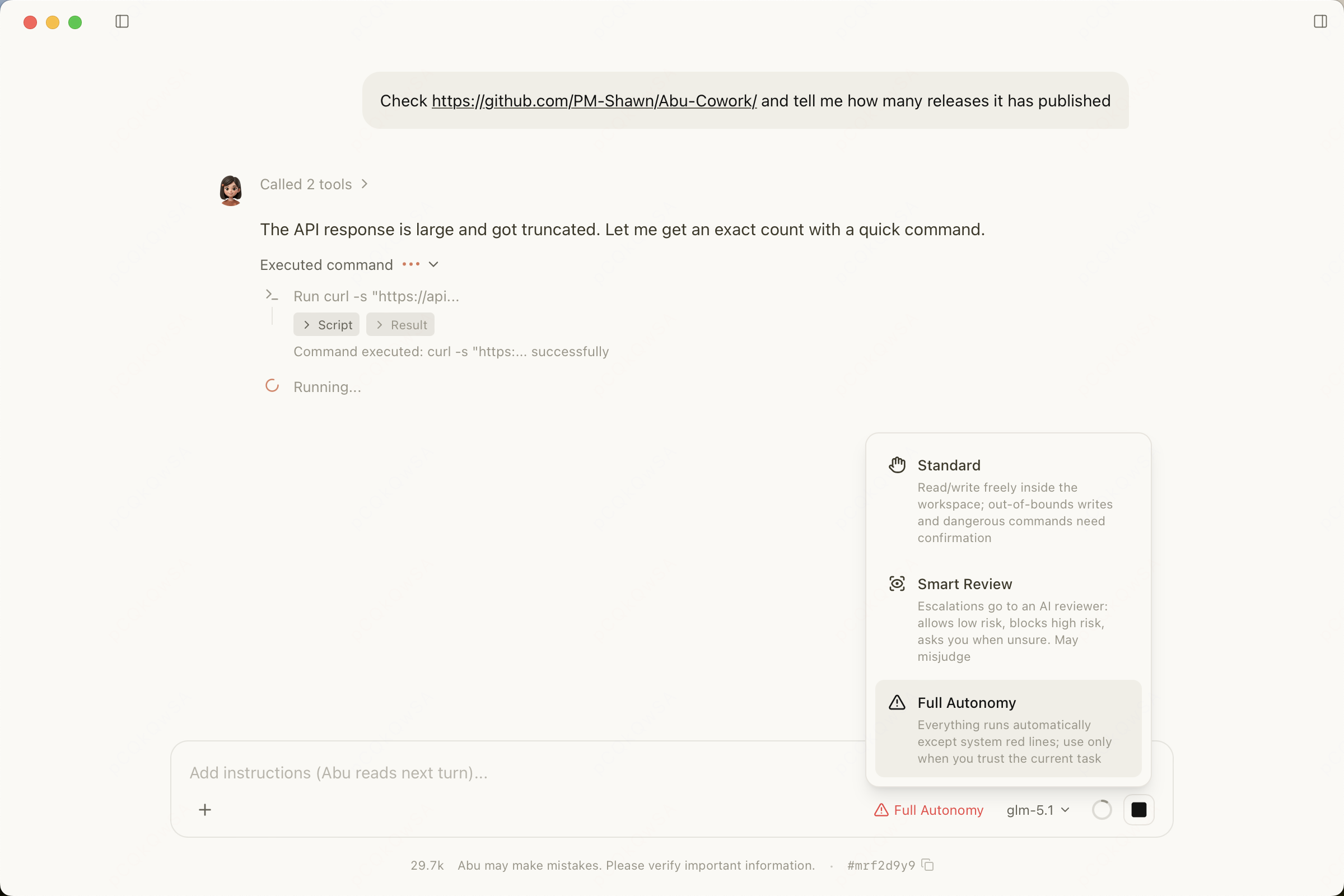 | |
Features
Core Capabilities
- Autonomous Agent — More than chat: plans, invokes tools, reads/writes files, executes commands, and completes complex tasks end-to-end
- Plan Mode — For high-risk steps (delete / overwrite / send / install), Abu first presents a step-by-step plan and waits for you to click "Confirm & run"; only read-only ops run while awaiting approval
- Interactive questions — When Abu needs you to decide (pick an approach, provide a parameter), it pops an option card above the composer; single or multi-select, with an "Other" free-text row
- Per-conversation settings — Permission mode (Request Approval / Smart Review / Full Autonomy) and model can be switched per conversation without bleeding across chats
- Soul Personality System — Three proactivity presets (Quiet / Buddy / Butler) decide when Abu speaks up; customize tone, address, reply style, and boundaries via
SOUL.md - Self-Evolving Skills — After you run a multi-step complex flow, Abu proactively offers "want to crystallize this into a skill?" — one click drafts it, you review, you accept. Next time, just name the skill; no need to re-explain
- Smart Notification System — Menubar unread count / sidebar badge / system notification auto-routed; notices queued to inbox while you're in fullscreen / DnD, surfaced via badges once you're back; audit trail kept for 180 days
- Projects — Promote a workspace into a Project: conversations in the same direction auto-aggregate; each project gets its own default model, skill set, and MCP connectors
- Multi-Agent Parallel Execution — Run up to 5 background agents simultaneously, each executing tasks independently with real-time progress tracking
- Desktop Pet (Labs) — Transparent floating window; left-click opens main window, right-click menu, drag-to-edge dock; activity tray shows Abu's live status (working / awaiting approval / done) and lets you reply inline while it waits
- Theme switching — Light / dark / system, via Settings → Appearance
- Labs — In-progress features, off by default, opt-in, may change or be removed (currently hosting: Desktop Pet)
- Conversation Sharing — Export any conversation to JSON in one click; API keys and local paths are auto-redacted before sharing
- 29 Built-in Skills — PDF/PPTX/DOCX/Excel generation, frontend design, canvas design, algorithmic art, Mermaid/SVG/infographics, Abu's built-in browser, optional Chrome bridge, deep research, Agent self-reflection (reflect), workflow automation, and more — one-click install, fully customizable
- MCP Protocol — Connect to databases, search engines, GitHub, and other external services via Model Context Protocol
- Browser Automation — Zero-setup built-in browser for ordinary web tasks, plus an optional Chrome extension bridge for existing tabs and signed-in sessions
- Computer Use — Screenshot + mouse/keyboard control for desktop-level tasks, with sensitive app blocking, dangerous key interception, and a 5-minute session timeout
- HTTP Fetch — Built-in safety gateway: URL length cap, embedded credential blocking, cloud metadata endpoint blocking, 10 MB download limit, 60-second timeout — no more raw
curlblind spots
AI Services & Models
- 12+ Cloud Providers — Anthropic Claude, OpenAI, DeepSeek, Qwen (Bailian), Doubao (Volcengine), Moonshot, Zhipu GLM, MiniMax, SiliconFlow, Qiniu, OpenRouter, and more
- Local Models — Zero-config Ollama integration with automatic local model discovery
- Custom Endpoints — Connect any OpenAI-compatible or Anthropic-compatible API
- Provider Management — Add, edit, delete, reorder providers with connection health checks and latency detection
- Model Selector — Switch models on-the-fly during conversations with capability badges (vision, tool use, web search, thinking, image generation, long context)
- Favorites & History — Star frequently used models, quickly switch between recent ones
- Image Generation — Built-in DALL-E 2 / DALL-E 3 support, plus any custom image-generation endpoint
Web Search
- Multiple Search Engines — Bing, Brave, Tavily, SearXNG (self-hosted, no API key needed)
- Independent Configuration — Search engine settings decoupled from main AI service
Automation & Triggers
- Scheduled Tasks — Cron-based scheduling (e.g., daily AI news digest at 9 AM); runs missed while the app was closed are replayed in time order on next launch
- Trigger System — Multiple event sources to automatically invoke agents:
- File Watcher — Monitor file create/modify/delete events with glob patterns
- HTTP Webhook — Auto-generated POST endpoints for external callbacks
- IM Messages — Trigger tasks on specific incoming messages
- Cron Schedule — Periodic execution on a time-based plan
- Trigger Permission Model — Four capability levels (read-only → safe tools → full access → custom whitelist) for fine-grained control
IM Channel Integration
Turn Abu into your team bot — just @Abu in your chat:
- Supported Platforms — D-Chat, Feishu (Lark), DingTalk, WeCom, Slack
- Session Management — Auto-isolate conversations by user/group/thread, auto-archive on timeout, "continue last" recovery
- Security Controls — User allowlist, workspace path restrictions, capability level enforcement
- Response Modes — Mention-only or all-messages
Memory & Context
- Three-tier file-based memory (Memdir architecture):
- Personal Memory —
~/.abu/memory/multi-file directory, applies across all projects, auto-organized by topic withMEMORY.mdindex injected into the prompt - Project Memory —
~/.abu/projects/<workspace>/memory/auto-isolated per workspace, each entry is a separate.mdfile for easy reading, search, and pruning - Auto-migration — Legacy
~/.abu/agents/abu/memory.mdand{workspace}/.abu/MEMORY.mdare migrated automatically on startup
- Personal Memory —
- Project Rules (hand-written):
~/.abu/ABU.md— User-level rules (cross-project){workspace}/.abu/ABU.md— Project-level rules{workspace}/.abu/rules/*.md— Modular rules (loaded alphabetically, max 20 files)
- Project Aggregation — Promote a workspace into a Project to aggregate its conversations; older conversations auto-backfilled with
projectIdon startup. Each project can independently configure default model, skill set, and MCP connectors - Session Memory — Large tool outputs automatically persisted to disk; compact summaries kept in-context to prevent context explosion
- Persistent Todos — Per-conversation
todo_writeplans persisted to disk and survive app restarts - Auto-Compaction — Intelligently compresses long conversation history while preserving key context
Security & Privacy
- Three Permission Modes — Request Approval (free read/write inside workspace; out-of-bounds writes and dangerous commands need confirmation; default) / Smart Review (out-of-bounds ops go to an AI reviewer: allow low-risk, block high-risk, ask only when unsure) / Full Autonomy (everything runs automatically except hard system red-lines); global default in Settings → Sandbox, also switchable per conversation via the chip above the composer
- Content Safety Scan — Scans agent-authored skills / memory entries to catch dangerous instructions, prompt injection, hardware commands, and 120+ other risk patterns
- OS Sandbox — macOS Seatbelt (
sandbox-exec) / Windows PowerShell ConstrainedLanguage isolates shell command file access - Network Isolation — Local proxy + domain whitelist + private-network toggle to control every outbound request
- Path & Command Safety — Sensitive directories (system folders, SSH keys, etc.) blocked by default; dangerous commands (
rm -rf /, etc.) caught statically - Computer Use Safeguards — 15+ blocked sensitive apps (Keychain, System Settings, WeChat, Slack, etc.), dangerous key interception (Cmd+Q, Cmd+Tab, Force Quit), session-level window hiding, 5-minute timeout
- Encrypted API Key Storage — Windows DPAPI / macOS AES-256-GCM with a hardware-UUID-derived key; keys are no longer written to localStorage in plaintext
- Local-First — Your data stays local, your API keys stay local — nothing goes through third-party servers
- Cross-Platform — Supports macOS (Apple Silicon / Intel) and Windows
Diagnostics & Troubleshooting
- One-Click Self-Check — Settings → Diagnostic, runs through AI service connectivity, data & permissions, MCP, skills, network, app environment
- Diagnostic Bundle Export — When something breaks, package logs / config / version info in one click (API keys and paths auto-redacted) and send it to the maintainer
For detailed feature documentation, see the User Guide
Download
Head to GitHub Releases to download the latest version:
| Platform | File |
|---|---|
| macOS (Apple Silicon) | Abu-x.x.x-mac-arm64.dmg |
| macOS (Intel) | Abu-x.x.x-mac-x64.dmg |
| Windows x64 | Abu-x.x.x-windows-x64-setup.exe |
Official macOS packages are signed and notarized. The Windows installer is current-user only and does not need administrator rights, but remains Authenticode-unsigned; SmartScreen may require More info → Run anyway. See the Installation Guide.
Quick Start
1. Configure AI Service
Open Abu → Settings → AI Service Management:
- Quickest setup: Choose a provider (e.g., DeepSeek, Anthropic), enter your API Key, click verify
- Local models: Install Ollama — Abu auto-discovers local models, no API key needed
- Custom endpoint: Enter any OpenAI-compatible API's Base URL and Key
2. Start Chatting
Return to the main screen, use the model selector to pick your preferred model, and start chatting.
Try these prompts:
Organize the files on my desktop by type
Extract the tables from this PDF and generate an Excel file
Every morning at 9 AM, search for the latest AI news and generate a daily digest
Use the frontend design skill to create a product landing page
Create a weekly report PPT for this week
3. Level Up
- Install skills: Settings → Customize → Skill Store — install PDF, PPT, frontend design, and more
- Connect MCP: Settings → MCP Connectors — one-click integration with GitHub, Playwright, etc.
- Set up schedules: Have Abu automatically search news, run data, send reports daily
- Connect IM: Settings → IM Channels — let your team @Abu directly in Lark/DingTalk
For more use cases, see the User Guide
Built-in Skills (29 total)
| Category | Skills |
|---|---|
| Document Generation | PDF, PPTX, DOCX, XLSX |
| Design & Creative | Frontend Design, Canvas Design, Algorithmic Art, SVG Diagram, Mermaid Diagram, Infographic, Slack GIF Creator, HTML Widget |
| Browser Automation | Abu-Browser (built-in, isolated session), Abu-Chrome-Bridge (optional Chrome extension for existing tabs and sign-in state) |
| Developer Tools | Claude API, MCP Builder, Web Artifacts Builder, Webapp Testing (Playwright) |
| Content Writing | Doc Co-authoring, Brand Guidelines, Internal Comms |
| Automation | Schedule, Trigger, Alert SOP |
| Project Management | Skill Creator, Project Init, Create Agent |
| Agent Reflection | Reflect — lets the agent look back on a run and distill learnings |
| Theming | Theme Factory (10+ preset themes applicable to any artifact) |
Beyond built-ins, Abu also supports Self-Evolving Skills — after multi-step complex flows, Abu proactively suggests "crystallize this into a skill" and grows a library tailored to your workflow. See User Guide → Skill System.
Tech Stack
| Layer | Technology |
|---|---|
| Desktop Framework | Electron (main + preload + isolated React renderer) |
| Frontend | React 19 + TypeScript (strict) + TailwindCSS v4 + Vite |
| LLM Adapter | Dual-protocol adapter (Anthropic / OpenAI-compatible) |
| State Management | Zustand + Immer + Persist |
| Tool Protocol | MCP (@modelcontextprotocol/sdk) |
| Web Search | Bing / Brave / Tavily / SearXNG |
| Sandbox | macOS Seatbelt + path/command dual validation |
| UI Components | Radix UI + Lucide Icons + shadcn-style |
| Testing | Vitest + happy-dom (covers core store / agent / skill / memdir modules) |
| Evaluation | Built-in OpenAI-protocol tool-selection eval runner (npm run eval:tool-selection) |
Build from Source
Prerequisites
- Node.js 24 and npm
- Rust stable (Install Rust) for the native helper and sandbox launcher
- Platform build tools: Xcode Command Line Tools on macOS, or Visual Studio Build Tools on Windows
Development
# Clone the repo
git clone https://github.com/PM-Shawn/Abu-Cowork.git
cd Abu-Cowork

# Prepare worktree-local dependencies, Electron/browser runtimes, sidecar,
# native helper, sandbox launcher, and the OSS renderer
npm run setup:electron-dev

# Launch the Electron desktop app. The OSS renderer is rebuilt before launch.
npm run electron:dev

# Enterprise worktree: prepare and launch the private Enterprise renderer
npm run setup:electron-dev:enterprise
npm run electron:dev:enterprise

# Frontend-only preview (not desktop acceptance)
npm run dev
Tauri is not a feature-development or acceptance target. Its source remains only for compatibility with already shipped versions, migration, and rollback.
Build
npm run dist:electron
Build artifacts are written to release-electron/. Build and validate distributable packages on the target operating system; a macOS cross-build is not Windows acceptance.
Source/fork packages do not use Abu's production updater or migrate installed Abu data. If you plan to distribute a modified build, read the Fork & Distribution Guide first.
Testing
npm test              # Run tests
npm run test:watch    # Watch mode
npm run test:coverage # Coverage report
npm run lint          # ESLint check
Project Structure
src/
├── components/       # React UI components
│   ├── chat/         # Chat interface, messages, model selector
│   ├── sidebar/      # Sidebar navigation (with collapsed Recents search)
│   ├── panel/        # Right-side detail panel (workspace, project memory/instructions)
│   ├── customize/    # Customization (skills, agents, models)
│   ├── schedule/     # Scheduled task views
│   ├── trigger/      # Trigger ("on-call") management views
│   ├── settings/     # System settings (16 panels, see settings/sections/)
│   ├── preview/      # File preview (PDF/Office/image/Markdown)
│   └── ui/           # Base UI components (shadcn/Radix)
├── core/             # Core engine (non-UI)
│   ├── agent/        # Agent loop, background agents, project rules
│   ├── llm/          # LLM adapter layer (Claude / OpenAI-compatible / Ollama)
│   ├── tools/        # Tool registry, built-in tools, safety checks
│   ├── mcp/          # MCP client
│   ├── skill/        # Skill loading & preprocessing
│   ├── search/       # Web search (Bing/Brave/Tavily/SearXNG)
│   ├── memdir/       # File-based memory system (personal/project, multi-file + index)
│   ├── scheduler/    # Scheduling engine
│   ├── trigger/      # Trigger engine (HTTP/file/cron/IM)
│   ├── im/           # IM channel adapters (D-Chat/Lark/DingTalk/WeCom/Slack)
│   ├── permissions/  # Permission model & capability levels
│   ├── context/      # Context management & auto-compaction
│   ├── session/      # Session management & disk persistence
│   ├── sandbox/      # Sandbox configuration
│   ├── logging/      # Structured logging
│   └── updates/      # Auto-update channel
├── eval/             # Tool-call / model capability eval scaffold (developer use)
├── stores/           # Zustand state management
├── hooks/            # React Hooks
├── i18n/             # Internationalization (Chinese / English)
├── types/            # TypeScript type definitions
└── utils/            # Utility functions

builtin-skills/       # 29 built-in skills (one directory each)
builtin-agents/       # Built-in agent definitions (placeholder)
abu-browser-bridge/   # Browser bridge MCP Server
abu-chrome-extension/ # Chrome extension (used by the Abu-Chrome-Bridge skill)
electron/             # Electron main process, preload bridge, native hosts
sidecar/              # Agent/runtime sidecar process
src-tauri/
├── src/
│   ├── computer_use.rs    # Screenshot + mouse/keyboard + sensitive app blocking
│   ├── feishu_ws.rs       # Lark/Feishu WebSocket long connection
│   ├── overlay.rs         # Computer-use status overlay
│   ├── proxy.rs           # Network isolation proxy
│   ├── sandbox.rs         # macOS Seatbelt / Win ConstrainedLanguage
│   ├── trigger_server.rs  # HTTP trigger server
│   └── window_info.rs     # Behavior awareness (active app sampling)
└── tauri.conf.json
Documentation
| Document | Description |
|---|---|
| User Guide | Complete product features and usage instructions |
| Installation Guide | Platform-specific installation and troubleshooting |
| Fork & Distribution Guide | App identity, updater, signing, migration, and release boundaries for forks |
Contributing
Issues and Pull Requests are welcome. Read the Fork & Distribution Guide before shipping a modified desktop package.
- Fork this repo
- Create your branch:
git checkout -b feat/my-feature - Commit your changes:
git commit -m 'feat: add my feature' - Push to the branch:
git push origin feat/my-feature - Open a Pull Request
License
Apache License 2.0 — Free to use, modify, and distribute, including commercial use. Copyright notices must be retained. Enterprise edition requires a license, offering team collaboration, SSO, audit logs, and private deployment support. Contact us.
Related DeepSeek Harness Plugins
Browse Automation →
将冰冷的离别化为温暖的 Skill,欢迎加入数字生命1.0!Transforming cold farewells into warm skills? It's giving rebirth era. Welcome to Digital Life 1.0. 🫶

致你忘不掉的那个TA,你们干大模型都是码圣 It's giving rebirth era. Welcome to Digital Life 1.0. 🫶

Built by DeepSeek, for DeepSeek — a Swift-native macOS coding agent

创建你的 AI 角色,进入你的故事世界。和角色聊天、冒险、穿书,让每一次互动都留下羁绊