

DSH Advisor
☆ 1Advisor - Pair a second model that passively reviews each turn and injects notes. 搭配一个会在每轮对话被动注入见解和审查的副模型。
Get this plugin
Review the source, then continue to the publisher.
dsh plugin add dsh-advisor@latest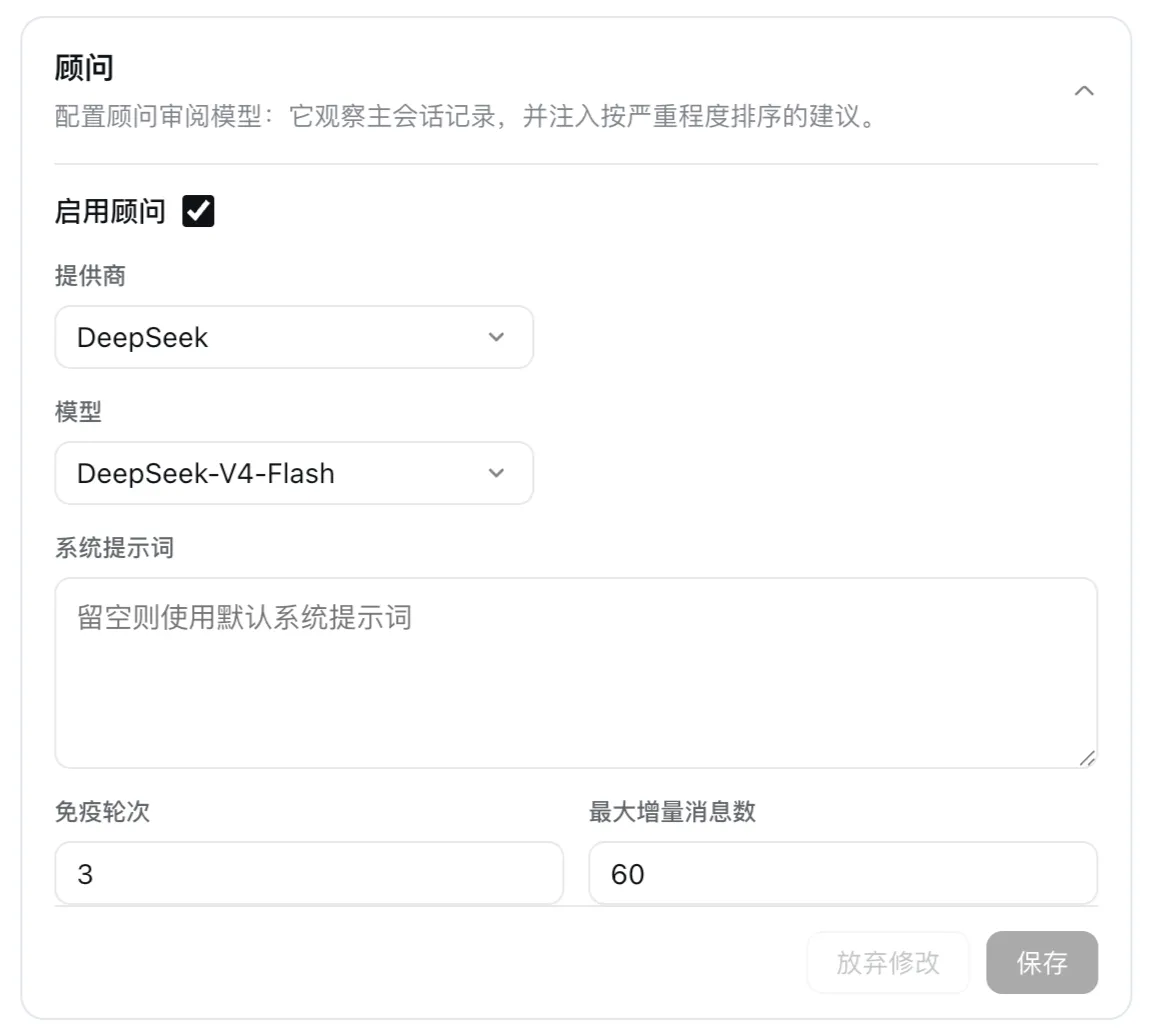
About this plugin
Source snapshot 8/13/2026dsh-advisor
English | 中文



A standalone dsh plugin bundle porting the omp "advisor" subsystem: a per-session reviewer model that observes the primary transcript, reviews each stepped turn with an explicitly configured model (provider + model are required), and injects severity-ranked advice (nit / concern / blocker) back into the session — without polluting or recursively reviewing itself.
Install with a single command (pnpm ≥ 10 needs one build-allow step — see Install):
dsh plugin --profile web add github:btspoony/dsh-advisor # <name> = your profile name; pin a commit with #<sha>
Advisory only. The advisor never approves or rejects the primary agent's actions; it never issues commands as if it were the primary agent. Every delivered message is self-described advisory content, and a misbehaving reviewer is bounded end to end (emission guard, immuneTurns cooldown, failure policy) so it can never stall or pollute the primary loop.
Install
One-line git install
dsh plugin --profile web add github:btspoony/dsh-advisor # <name> = your profile name; pin a commit with #<sha>
A git install fetches sources, not built artifacts, so the bundle builds
itself on install (prepare self-build). pnpm ≥ 10 blocks a git dependency's
prepare by default: the first
add fails with ERR_PNPM_GIT_DEP_PREPARE_NOT_ALLOWED, and pnpm prints the
exact package key — allow the build in the profile's pnpm-workspace.yaml
(onlyBuiltDependencies: [dsh-advisor], or run dsh plugin --profile web approve-builds), then re-run the add. Treat that allowance as permission to
execute the package's code on your machine at install time, and pin a commit
(#<sha>) so a later push cannot silently change what runs.
Local directory install (recommended for development / verification)
pnpm install                    # build the bundle (the prepare self-build)
dsh plugin --profile web add .  # <name> = your profile name
Verify
dsh --profile web --dump-config   # shows a "# == dsh-advisor" layer with the advisor row
dsh --profile web
Tarball install and uninstall are covered in docs/install.md.
Config
The advisor is off by default. When enabled, provider and model are
mandatory: enabled: true without both is a hard gate — the advisor never
starts a model call and reports a disabled-with-reason status. Unknown config
keys are rejected.
Configuration composes across three surfaces (later layers override earlier ones; every surface uses the same key set):
- Plugin-row config —
$DSH_HOME/profiles/web/cordis.patch.yml(below). This is the composition base. - dsh web Settings page — the "插件配置" (Plugin Configuration) page —
the Advisor card (id
advisor, rendered after the upstream bash / agent-loop / web-search cards) with the enabled toggle, provider / model selects restricted to system-configured providers and their models, and the optional fields. Saving writes into theadvisorsettings namespace and overrides the plugin-row config without editing it. Saving applies to new sessions immediately — no restart (the runtime reads the composed value live). Requires a current dsh web build whose shell declares thesettings.plugin.itemcard slot and loads packages that declaredsh.client. The card reads and writes the namespace through the officialGatewayServiceRPC channel (/api/advisor/get+/api/advisor/set, claimed by the host's typertGateway — the same mechanism the dshgoalsservice uses), which is not gated by the settings exposure allowlist: the in-process write (ctx.settings.update) carries no exposed-namespace check. No host patching is applied or required. /advisorcommand — per-session and ephemeral: it flips a session override, never the persisted config (see Usage).
Both persisted surfaces share the same hard gate: enabled: true with empty
provider/model never starts a model call (disabled-with-reason). The
Settings page additionally blocks saving while enabled with a required field
empty; the host-side gate stays the final line of defense on every path.
Plugin-row config:
# profiles/web/cordis.patch.yml — the profile's user patch layer
- id: advisor
  config:
    enabled: true              # master switch (default false)
    provider: deepseek-official  # REQUIRED when enabled
    model: deepseek-v4-flash     # REQUIRED when enabled
    systemPrompt: ""           # optional; "" = built-in reviewer prompt
    immuneTurns: 3             # int ≥ 0, default 3 — cooldown after a delivered interrupt
    maxDeltaMessages: 60       # int ≥ 0, default 60 — delta window; 0 = unbounded
| Key | Type / default | Meaning |
|---|---|---|
enabled | bool, false | Master switch. |
provider | string, optional | Provider route. Required (non-empty) when enabled: true. |
model | string, optional | Model id. Required (non-empty) when enabled: true. |
systemPrompt | string, "" | Overrides the built-in reviewer prompt (severity definitions + JSON-frame output contract). |
immuneTurns | int ≥ 0, 3 | After a concern/blocker is actually steered, the next N stepped primary turns must complete before another interrupting note may steer; notes inside the window downgrade to inject. |
maxDeltaMessages | int ≥ 0, 60 | Bounded advisor input window. Deltas beyond N are truncated with a … <earlier messages omitted> marker; 0 = unbounded. |
Model capability & budget: the advisor call runs with reasoningEffort: 'off' — sent only when the configured model's adapter declares that effort
(deepseek models do; any other model gets the option omitted automatically, so
non-reasoning providers keep working) — and a 5120-token output cap (a
user-directed 20× supersession of the original 256). Extracted notes are
bounded (1000 chars) and the notice summary to 120 chars, so the raised budget
cannot translate into an unbounded injection into the primary session.
Usage
Once installed and enabled, the advisor observes every session. Control it per
session with the /advisor command (available when a command registry is
composed):
/advisor            toggle the advisor for this session
/advisor on         enable the advisor for this session
/advisor off        disable the advisor for this session
/advisor status     show state, model, runtime status, pending count, last activity
/advisor on|off|toggle are session-scoped and ephemeral: they flip a
per-session override, never the persisted config. Enabling a session whose
config lacks provider/model starts no model call — /advisor status (and
the /advisor on reply) shows the gate reason.
/advisor on is also the manual recovery path: a session advisor paused by a
quota/rate-limit (quota_exhausted — KD-5 has no auto-resume timer) resumes in
place, and a halted advisor (permanent model error, e.g. invalid credentials)
is rebuilt fresh for the session.
The advisor reviews on a dual-mode trigger, depending on the session shape:
- Standard stepped sessions — after each stepped primary turn that ends
normally (
completed,max-tokens, orerror), the advisor reviews the incremental transcript delta. - Agentic / harness sessions (never emit
turn/end) — after each completed agent reply round: when a new human input arrives (inbox-spliced input included) after an unreviewed assistant increment, the advisor reviews that increment.
Either way the advisor emits at most one note per review, ranked by severity:
- nit — a minor style, clarity, or quality suggestion; delivered via
agent.inject(non-waking, consumed at the next pre-step boundary). - concern — a material risk or clearly better direction to weigh before
continuing; delivered via
agent.steer(waking), subject to theimmuneTurnscooldown. - blocker — continuing clearly wastes work (contradicts an explicit user
instruction, going in circles, fundamentally unsound); delivered via
agent.steer.
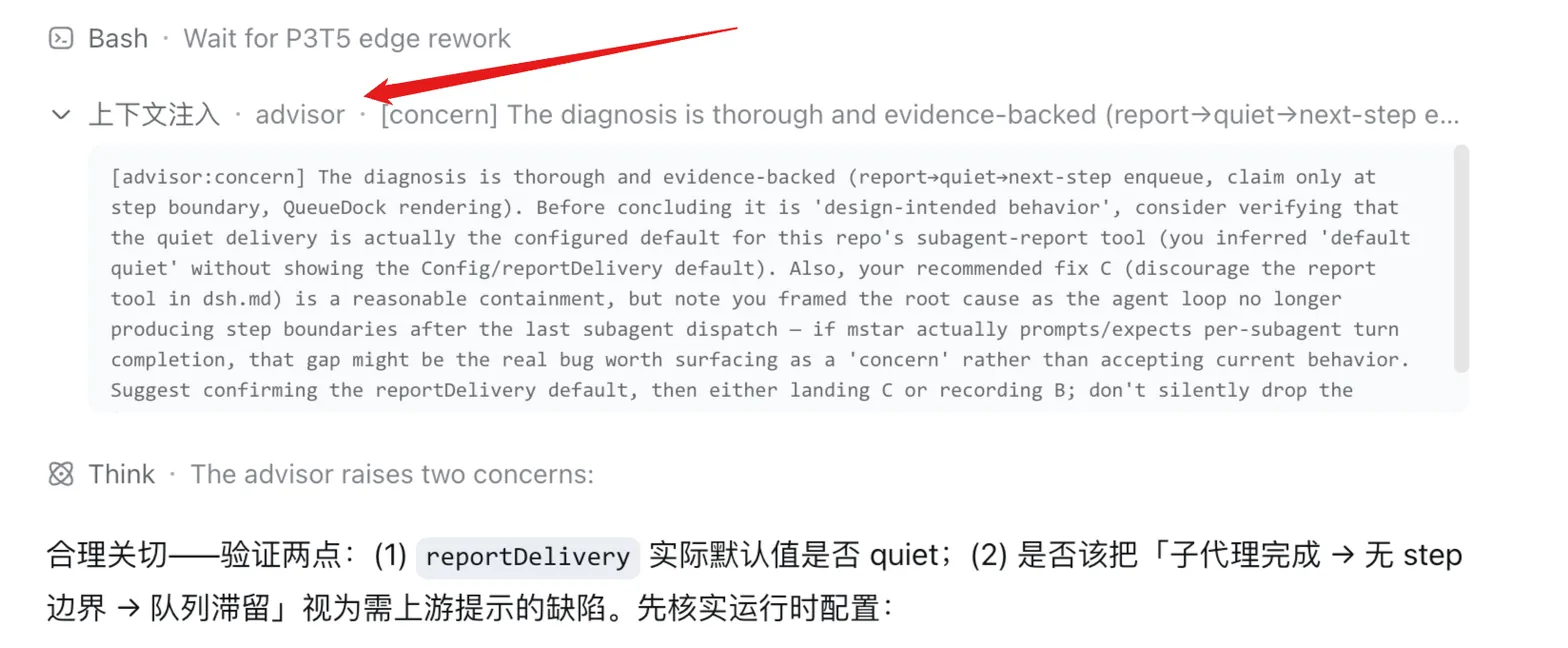
Injected advice appears in the session stream as a user-role message carrying the advisor source kind and self-describing content, e.g.:
[advisor:concern] extract the helper into a module and unit-test it
The [advisor:{severity}] prefix is the only cue the primary model gets about
how to treat it — the primary system prompt never mentions advisories. Advisor
messages are excluded from later advisor deltas, so the advisor never reads
its own advice back.
How it works
The plugin subscribes to session/event. Two triggers render an incremental
markdown delta of the primary transcript (own advisor messages excluded) and
queue it on a per-session runtime: after each stepped turn/end in standard
stepped sessions, and — in agentic/harness sessions that never emit turn/end
— when a new human input arrives (inbox-spliced input included) after an
unreviewed assistant increment, i.e. at each completed agent reply round. The
runtime calls a separately configured model via ctx.llm.stream, extracts one
{note, severity} from the JSON-framed reply, gates it through an emission
guard (normalize / dedupe / content-free suppression / one-note-per-update),
and routes it: nit → inject, concern/blocker → steer. The advisor call runs
with reasoning off and a 20x token budget so the JSON note is never starved by
reasoning output. Compaction and surface rewrites reset the observer, the
emission guard, and the immuneTurns latch
(KD-5); the drain is fully async with a bounded backlog, so a failing or
quota'd advisor can only drop its own backlog — never park the primary loop.
Limitations & roadmap
The MVP deliberately drops full omp parity. Accepted gaps (tracked in the harness iteration roadmap):
- Single advisor per session — no parallel advisor roster or WATCHDOG-style file discovery (next iteration).
- No advisor tools — the reviewer is an independent model call only; it cannot verify claims itself (next-next iteration).
- No in-session advisor panel — advice surfaces only as tagged injected messages (the Advisor card on the "插件配置" settings page is a config surface, not a session view; an in-session card is next-next iteration).
- No transcript persistence or cost stats — no resumable advisor history or cost observability (next-next iteration).
- No secret obfuscation of delta content — secrets present in the transcript can reach the advisor model; mitigate by configuring a trusted reviewer model.
- No quarantine of unsafe advisor output — a misbehaving note can carry
directive text; the JSON frame + validation + advisory-only framing
(
[advisor:…], "weigh, don't blindly obey") are the only mitigation, and the note is delivered as-is into the primary transcript (roadmap). - No
syncBacklogcatch-up wait — a far-behind advisor does not wait for the primary loop; its backlog is bounded and dropped (never parks the primary), so advisor notes may arrive after the next primary turn started (roadmap: context-maintenance batch). - Bounded advisor context — long-session full replays are truncated
(
maxDeltaMessages), so the advisor may lose early context after compaction; advisor context maintenance is roadmap (next-next iteration).
Development
The bundle builds itself on install: package.json declares "prepare": "node scripts/setup-dsh-links.mjs && pnpm build" (the dev-time link farm plus the
same build prepack runs), so any clone is
immediately buildable once DSH_HOME points at a dsh home whose
source/current is a dsh source tree (or DSH_SOURCE_DIR points at such a
tree directly). The private
@deepseek-ai/dsh-* runtime dependencies are peerDependencies only; at dev
time scripts/setup-dsh-links.mjs (wired into prepare, standalone as
pnpm dsh:link, verified with pnpm dsh:link:check) links the REAL packages
from that tree into node_modules/@deepseek-ai/ — every @deepseek-ai/*
package the tree declares (tool CLIs with a bin are skipped: linking them
would make pnpm write their bins into the shared tree), a bin-less shim for
the in-box cordis framework, and the tree's own react/react-dom copies
(node resolution — including externalized CJS deps — must see ONE react
identity, the identity the real client packages use; the dsh profile
convention nodeLinker=hoisted lives in pnpm-workspace.yaml (pnpm 11+
ignores non-auth settings in .npmrc), so no .pnpm per-package dirs shadow
those links). The farm is idempotent, prunes stale entries, and fails with
guidance when the tree is missing or a peer cannot be linked.
pnpm-workspace.yaml also sets autoInstallPeers: false (dsh profile
convention): the private peers must never be fetched from the npm registry.
export DSH_HOME=~/.dsh    # a dsh home with source/current (or set DSH_SOURCE_DIR)
pnpm install              # registry deps + link farm (via prepare), no private-registry access
pnpm test                 # vitest (unit + the composed integration loop)
pnpm typecheck            # tsc --noEmit (node) + tsc -p tsconfig.client.json --noEmit + tsc -p tsconfig.spec.json --noEmit
pnpm build                # tsc -p tsconfig.build.json emit to lib/ + node scripts/build-client.mjs (client bundle)
pnpm pack                 # build + produce dsh-advisor-0.0.1.tgz
On Windows the link farm creates directory entries as junctions (no special
privileges), but the cordis shim's file entries use file symlinks, which need
Developer Mode
(or an admin shell) — enable it before pnpm install. Windows has no
HOME, so the script falls back to USERPROFILE to resolve the dsh source
tree.
The in-box cordis framework is declared as the scoped peer
@deepseek-ai/cordis: ^4.0.1-rc.1 (the range carries the exact publish tag —
a comparator prerelease such as ^4.0.0-rc.7 never matches the vendored
4.0.1-rc.1 per the node-semver tuple rule); after install the link farm's
bin-less cordis shim at node_modules/@deepseek-ai/cordis answers the scoped
name and resolves to the vendored files, because the real packages type and
run against the vendored build and module identity requires dev-time
import '@deepseek-ai/cordis' to resolve to the same files. The public
devDependencies (schemastery, react, …) resolve from the npm registry as
usual.
prepack runs pnpm build; prepare runs the link farm and the build, so
pnpm pack runs the build twice (once per lifecycle) — the documented
tradeoff that keeps git-install builds working. There is no postinstall
step: already-built tarball installs skip the build entirely.
The integration test (tests/integration.test.ts) composes the plugin into a
real cordis context with a stub LLM adapter and drives the full
turn → delta → advisor call → inject/steer cycle.
Documentation
| Doc | Content |
|---|---|
| docs/install.md | full install guide: git / tarball / local-directory install, web Settings exposure, uninstall, --dump-config verification |
License
MIT
Related DeepSeek Harness Plugins
Browse Models →
Pure mathematics for agents: search for examples and counterexamples, compute exactly, and independently check what a result proves.
Code intelligence for agents: find the code that matters and keep your context window and tokens lean.

Code verification protocol for vibe coding — every claim must have a verifiable practice anchor.

给 DeepSeek 等纯文本大模型外挂图像理解能力的实现无感添加视觉能力。提供 OpenAI 兼容的 API,自动将图片请求交给视觉模型分析,再将结构化结果注入文本模型,使增强后的模型体验接近原生多模态。